Ask anyone past forty and they will tell you the same thing, usually with a note of quiet alarm: the years are moving faster. A childhood summer once stretched to the horizon, an unbroken country of long afternoons. Now whole decades seem to fold up and disappear between one glance at the calendar and the next. Children are born and start school in what feels like a single season. You look up, and it is September again, and then it is September again.
The strange part is that nothing about time has actually changed. A year is still 365 turns of the earth; an hour is still sixty minutes, ticking at exactly the rate they ticked when you were eight and an hour could contain an entire universe. The clock is innocent. Whatever is accelerating, it is not time. It is us.
The question of why has occupied philosophers and psychologists for a century and a half, and the best answer turns out to be both more interesting and more unsettling than the folk wisdom about time simply "flying." The years are not being taken from you faster. You are recording fewer of them.
The Oldest Answer: A Year Is a Smaller Slice of a Longer Life
The most familiar explanation is also the most mathematical, and it has a certain undeniable elegance. In 1877, the French philosopher Paul Janet proposed what is now called the proportional theory: that we judge the length of a stretch of time against the total time we have already lived.
To a five-year-old, a single year is a full fifth of conscious existence — an enormous, weighty fraction. To a fifty-year-old, that same year is one-fiftieth of the whole, a thin sliver by comparison. If our sense of duration is relative rather than absolute, then each successive year must feel smaller than the last, not because it is, but because the yardstick keeps getting longer. On this view the interval from five to ten, proportionally, feels equivalent to the entire span from fifty to a hundred. Subjective time runs not on a straight scale but a compressing one, and by the grim arithmetic of the theory, a surprising share of the life you will ever feel is already behind you by early adulthood.
It is a tidy idea, and there is surely something to it. But most researchers have never found it fully satisfying, for a simple reason: it is only a formula. It describes a ratio without explaining a single thing about how the mind actually produces the sensation of time. It tells us that a year should feel shorter without telling us why it does — what is happening inside a person that makes the felt texture of a decade thin out. For that, you have to look not at arithmetic but at memory.
Time Is Measured in Memories
Here is the deeper mechanism, and it was already visible to the founders of psychology. When William James considered the problem in 1890, he located the answer not in ratios but in the contents of recollection. In youth, he observed, experience is a dense thicket of firsts; in later life, "the days and weeks smooth themselves out in recollection to a monotonous, memorable flatness," and the years grow hollow and collapse.
The insight modern research has built on his is this: we do not perceive the length of a past period directly. We reconstruct it, after the fact, from how much we remember of it. A stretch of time crowded with distinct, vivid memories reads, in retrospect, as long. A stretch that left almost nothing behind reads as short — as if it barely happened at all.
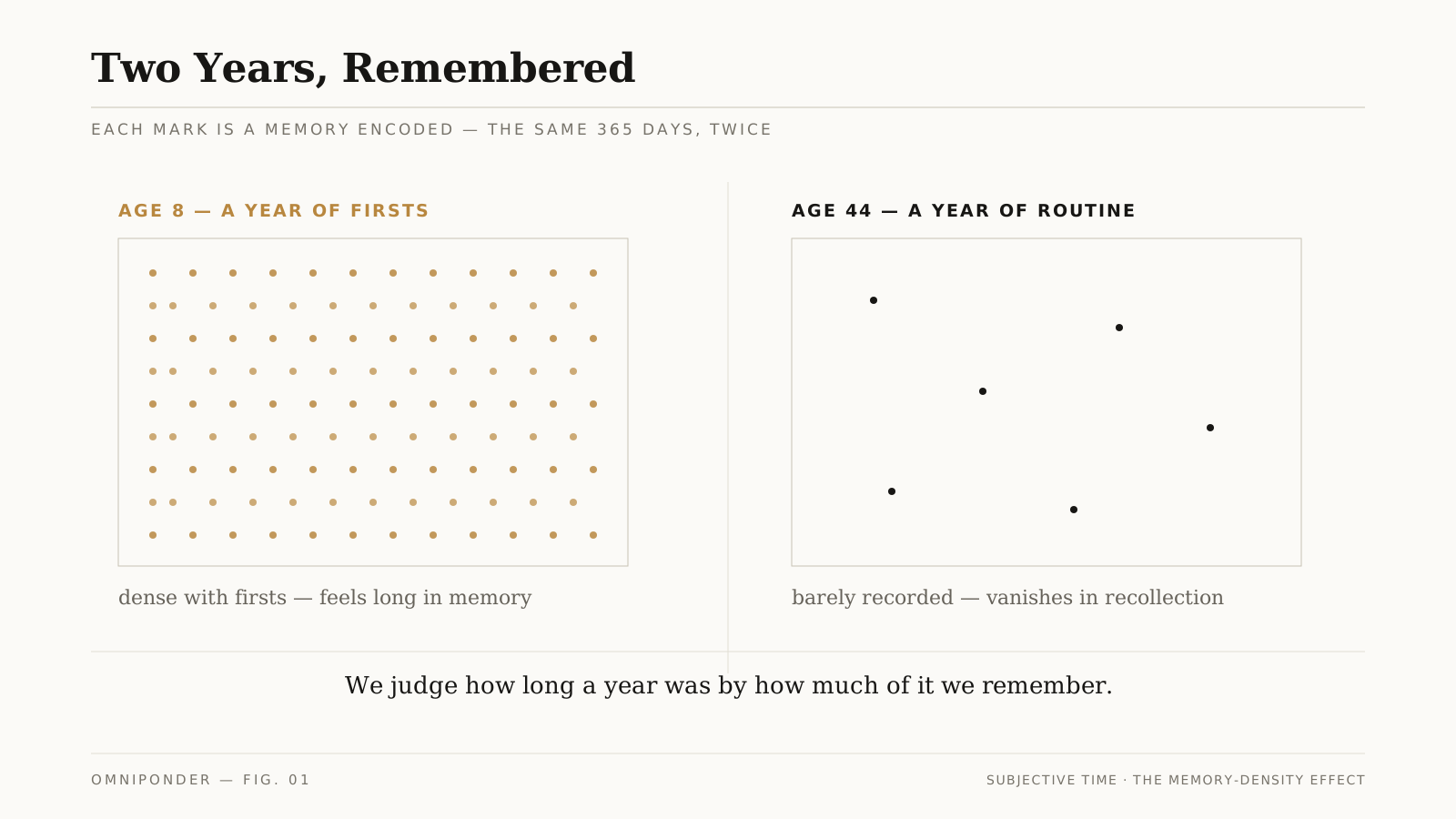 Caption: We measure a past year not by its days but by its memories. Childhood lays down many; a routine adult year lays down almost none — so it vanishes in recollection.
This is why novelty is the true currency of subjective time. The brain encodes new experiences richly and lazily skips the familiar, and childhood is nothing but novelty — a relentless sequence of things happening for the very first time. The first day of school, the first ocean, the first funeral, the first time riding a bicycle without a hand on the seat: each is laid down in dense, high-resolution memory, and the years that hold them swell accordingly in recollection. Psychologists even have a name for the residue of this: the reminiscence bump, the well-documented fact that people recall a wildly disproportionate share of their life's memories from roughly ages ten to thirty, when most of the firsts occur. Those years feel, from the far side, enormous — because they are, in the only sense that memory can measure.
Adulthood, by contrast, is the slow triumph of repetition. The same commute, the same work, the same faces, the same route through the same grocery store. The brain, efficient to a fault, sees little worth writing down, and so it doesn't. A year of genuine routine can pass leaving barely a handful of distinct memories, and a year that left no memories is, in retrospect, indistinguishable from no time at all. This also resolves a puzzle everyone has felt — the holiday paradox, described by the writer Claudia Hammond: a week somewhere new races by while you are living it, yet looms large and long when you look back, precisely because it was dense with the novel impressions the brain bothered to keep.
Why the Brain Stops Writing Things Down
To understand why the recording thins with age, it helps to see what the brain is actually for. It is not a camera dutifully capturing everything. It is a prediction engine, and its entire economy runs on surprise.
Novel experience carries information — it violates expectation, and so it must be attended to, processed, and stored. Familiar experience carries almost none; it confirms what the brain already knows, and so it can be handled on autopilot, predicted rather than perceived, and safely left unrecorded. This is a magnificent efficiency for staying alive. It is also, quietly, why life speeds up. As we age, we accumulate expertise about our own existence. More and more of what happens to us is something that has happened before, and the more predictable a life becomes, the less of it the brain judges worth encoding. The acceleration of time is, at bottom, the accumulation of the familiar.
There are other, more speculative pieces. Some researchers have proposed that the brain's raw processing rate slows with age, so that we sample fewer mental "frames" per unit of clock time and the world seems to slip by faster; the idea is intriguing but far from settled. The robust and repeatable finding is the one about memory. However the machinery works in detail, the pattern holds: we feel the length of our lives through what we retain, and with age we retain less of each passing day.
The Paradox of a Life on Autopilot
Follow this to its conclusion and it stops being a curiosity about clocks and becomes something closer to a warning about how to live.
If the years feel short because they were thinly recorded, and they were thinly recorded because they were lived on autopilot — predicted rather than experienced, moved through rather than noticed — then the sensation of time speeding up is really the sensation of a life passing without full attention. The vanished years did not vanish because they were dull to live. Many of them were not dull at all. They vanished because we were, in the way that matters most to memory, only half present for them. The mind that is running on prediction is, in a sense, somewhere else — and the time it spends there does not get saved.
That is the genuinely uncomfortable part. The complaint that time is flying is often, underneath, a report that we have stopped paying attention to our own lives.
How to Slow It Down
The consolation is that the same mechanism that steals the years also tells you exactly how to get them back, and it is not a trick or a hack. It follows directly from the science, and it comes in two parts.
The first is novelty, deliberately sought. Because the brain encodes the new and skips the familiar, anything that breaks the pattern buys back memory and, with it, felt time. A different route home, an unfamiliar city, a skill attempted badly for the first time in decades, a conversation with someone unlike anyone you know — each forces the brain out of prediction and back into recording. This is why a single week of travel can, years later, outweigh whole seasons of the life you cannot remember. It is not that the trip contained more hours. It contained more that you kept.
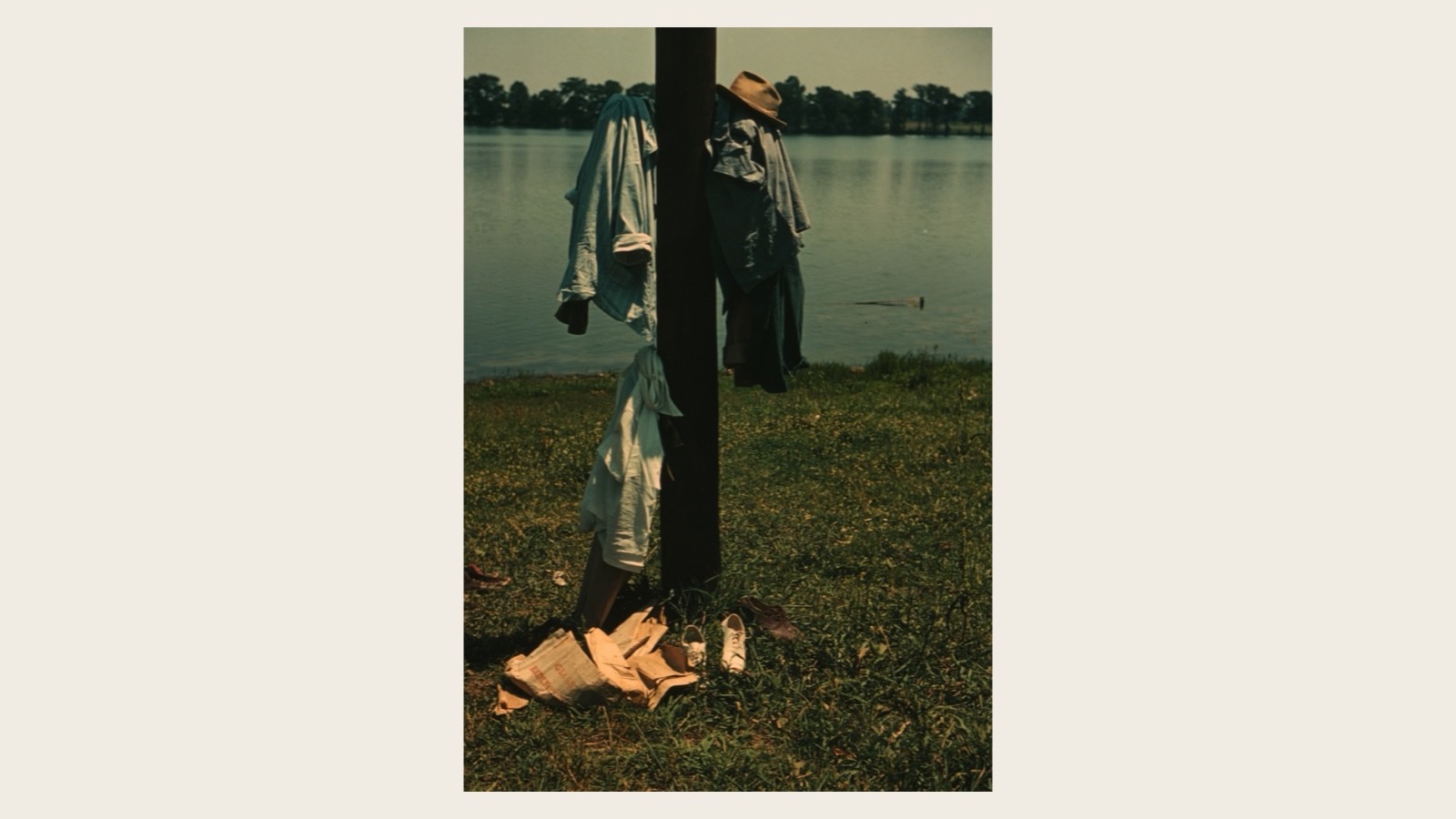 Caption: Swimmers' clothes on a pole by a Louisiana lake, 1940 — the children out in the water, wholly absorbed, not a thought spared for the time. The complete attention childhood gives by default. Marion Post Wolcott, Farm Security Administration; Library of Congress, public domain.
The second part is subtler and, in the end, more powerful, because you cannot fill a life entirely with novelty and most of it will always be ordinary. It is attention. The contemplative traditions have taught for millennia what the psychology of memory now quietly confirms: that it is possible to meet even a familiar moment as though it were new — to attend to the ordinary with the full, unhurried notice that childhood gave to everything by default. The endless summers were never really a gift of youth. They were a gift of first-ness, of a mind so new to the world that it paid complete attention because it had no choice. That quality of attention is not gone. It has only become optional, and it can be practiced.
The Length of a Life, From the Inside
Time does not speed up. We stop noticing it pass, and mistake our own inattention for the acceleration of the clock. The years we feel we have lost are, almost exactly, the years we did not trouble to record — the ones we spent predicting instead of perceiving, arriving instead of being anywhere.
There is a familiar, understandable wish, as the calendar pages turn faster, for simply more time. But the deepest implication of all this research is that more time is not really the answer, and might not even help; a longer life lived on the same autopilot would only feel short in the same way, at greater length. What lengthens a life from the inside is not duration but density — how much of it you were actually awake for. The difference between a year that lasts and a year that disappears is not the year. It is you, and whether you were there for it. The clock will keep its steady, indifferent time. Whether the years feel like a country or a corridor is, more than we like to admit, up to us.