This morning, in the highland town of San Juan Chamula in Chiapas, Mexico, UNESCO opened the sixtieth International Literacy Day. The occasion is older than the personal computer. When it was first observed in 1967, the problem it named was clear and almost entirely about access: well over a third of the world's adults could not read a sentence, and the work was to reach them — build the schools, print the primers, teach the letters.
Sixty years on, the letters have largely been taught. Global adult literacy now stands around 87 percent. And a different problem has arrived, one the founders would have struggled to picture: a growing share of people who can read perfectly well and increasingly choose not to — and now, for the first time, a machine that offers to do their reading for them.
That machine is very good, and getting better. Ask it to read the report, the contract, the long essay, and it will hand back a clean summary in seconds. This looks like pure gain, and often it is. But it quietly changes what the word literacy is measuring. For sixty years the question was can you read? The question underneath this anniversary is becoming will you — and if a competent machine will do it for you, why would you?
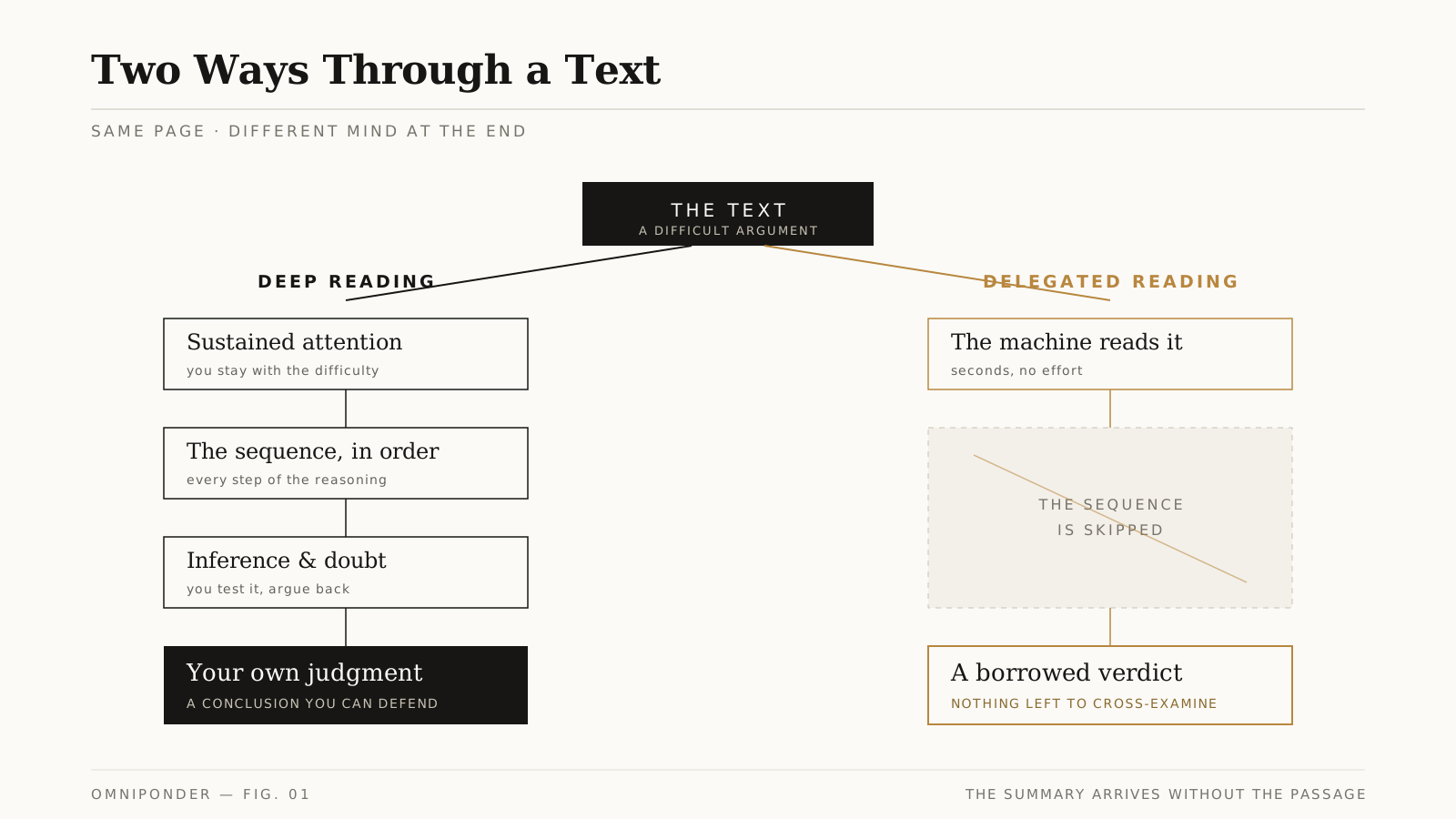 Caption: The same text, two routes. Only one of them leaves you able to check the conclusion you end up holding.
Reading Was Never Supposed to Happen
The first thing to understand about reading is that you were not built for it.
Spoken language is written into the species. Set a small child among talking people and speech arrives on its own, without lessons, on roughly the same schedule everywhere on Earth. The brain comes with scaffolding for it. Reading has no such scaffolding. There is no reading gene, no region of the cortex that evolution set aside for the printed word — because for almost all of human history there was no printed word. Writing is barely 5,000 years old, an eyeblink on the evolutionary clock, and for most of that time only a tiny elite used it.
So the reading brain has to be jury-rigged. As the cognitive neuroscientist Maryanne Wolf has spent a career describing, each of us who reads has forged a new circuit that was never standard equipment — wiring together regions built for vision, for spoken language, for memory and inference, into something that can turn marks on a surface into meaning in a mind. Every literate person is running a piece of custom cultural software on hardware that shipped without it.
This is the fact that should give us pause today. A capacity that is inherited is hard to lose; a capacity that must be rebuilt from scratch by every single person, through years of effort, is exactly the kind of thing a civilization can let slip. And what is most fragile in that capacity is not the decoding of words — recognizing cat on a page — but what Wolf calls the deep-reading processes layered on top of it: inference, analogy, critical judgment, the slow assembly of another person's thought inside your own head. That is the part that takes effort. It is also the first part to go when the effort stops.
The Oldest Complaint
There is an obvious objection, and it is worth taking seriously, because it is old and it is usually right.
Every new technology of thought has been met with exactly this alarm, and the alarm has usually been wrong. The first recorded version is about 2,400 years old. In Plato's Phaedrus, Socrates tells of the Egyptian god Theuth, who offers the gift of writing to King Thamus, promising it as a remedy for memory and wisdom. Thamus refuses the praise. Writing, he warns, will do the opposite: it will "implant forgetfulness," letting people trust the external marks instead of remembering for themselves, so that they acquire "the appearance of wisdom, not true wisdom." Plato, of course, wrote the warning down. We only have it because he did.
He was wrong, or at least the fear was. Writing did not hollow out human thought; it externalized memory and, in doing so, freed the mind to build on itself across generations. Print did not make people shallow; it spread literacy from an elite to a majority. The same panic was raised, in turn, about newspapers, the telephone, television, and the internet — and each time the more extreme predictions failed to arrive. A person who has learned this history is right to be suspicious of one more voice announcing that this time, finally, the machine will make us stupid.
So intellectual honesty requires the harder question. Not is someone worried — someone is always worried. The question is whether there is something structurally different about this shift, or whether it is just the newest verse of a very old song.
What Is Actually Different Now
There is something different, and it is precise.
Every earlier change was a change of medium. Clay tablet to papyrus scroll to bound codex to glowing screen — the container changed, but the act did not. Your eyes still crossed every line; the reading was still yours to do. Even the most-studied downgrade of the digital era stays inside that boundary. Comparing the same text on paper and on screen, researchers keep finding a modest but stubborn "screen inferiority" — slightly lower comprehension and recall from the screen, an effect that grows with longer and harder material and under time pressure. It is a real cost. But it is a cost paid by a reader who is still, however distractedly, reading.
Generative AI is not a change of medium. It is a change of the act. It does not merely hold the text and wait for your eyes; it offers to perform the reading and give you the result. The summary arrives without the passage. And this matters more than it first appears, because an argument's worth lives in the passage, not the summary. Whether a claim actually holds — whether the reasoning earns its conclusion or quietly cheats somewhere in the middle — is only visible if you walk the steps. The place you would have paused, the premise you would have doubted, the leap the author hoped you wouldn't notice: all of it is in the sequence that the summary throws away. Take the verdict without the trial and you are left holding a conclusion you have no way to cross-examine.
There is an early, contested hint that the delegation costs something neurologically as well. In 2025, researchers at MIT's Media Lab had people write essays with and without an AI assistant while recording their brain activity. The group that leaned on the model showed weaker neural engagement and, tellingly, were less able afterward to recall or quote what "they" had written. The researchers called the effect cognitive debt. It was a small and preliminary study, and it should not be oversold. But it points at something most of us already suspect from ordinary experience: a mind that does not do the work does not keep the work.
Where the Thinking Actually Happens
To see what is at stake, it helps to be concrete about what deep reading trains, because it is easy to mistake it for a literary luxury.
It is the discipline of staying with difficulty long enough for it to resolve — remaining inside a hard paragraph past the point of discomfort, until the sense of it clicks into place. It is the practice of holding two ideas that don't yet agree without collapsing one into the other. It is following an argument whose destination you cannot see from where you're standing, trusting that the steps will get you there. And it is the strange, valuable experience of disagreeing with a book — arguing back in the margin, catching the author in a move you don't accept.
 Caption: The Main Reading Room of the Library of Congress, Washington, D.C. Photograph by Carol M. Highsmith; Library of Congress, dedicated to the public domain.
None of those are decorative skills. They are the motor movements of judgment itself. A person who cannot sit with a difficult paragraph will struggle to sit with a difficult decision; the two require the same muscle. This is why the real risk of a post-literate society is not the one we usually name. The danger is not that people will become stupid — a population fed on fluent summaries may sound more informed than any before it. The danger is that they will become suggestible. A public that no longer reads deeply loses the ability to independently check the summaries it is handed, and a mind that cannot check what it is told will, in the end, believe whoever summarizes last.
The New Literacy
Sixty years ago, literacy was a threshold you crossed once. Could you decode the marks — yes or no. UNESCO's fight, still unfinished for the hundreds of millions who cannot read this sentence in any language, was a fight for access, and it remains a fully justified one.
But for the billions who can now read, the frontier has quietly moved from can to will. Literacy is becoming less a skill you possess than a practice you keep — the deliberate choice to read the hard thing slowly, in sequence, in your own head, precisely when a capable machine is offering, reasonably and helpfully, to spare you the trouble. That is a harder thing to teach than the alphabet, because it cannot be finished. It has to be chosen again every time.
The machine can read for you. It is genuinely good at it, and there are a thousand occasions when letting it is exactly the right call. But reading was never only the intake of information. It was the place where a person did the thinking that turns information into judgment — and those, until this decade, were the same act. The quiet task of the next sixty years is to keep them from coming apart: to remember that the point of reading a difficult thing was never to have read it, but to become the kind of mind that could.