For about fifty years, social scientists could count on one of the most dependable patterns they had ever found. Chart people's happiness against their age and you got a U. Life satisfaction ran high in youth, sagged to a low point somewhere around fifty, then climbed again through the retirement years. The economists David Blanchflower and Andrew Oswald documented the shape in a landmark 2008 paper, and Blanchflower later reported the same curve across more than 140 countries, rich and poor, with the trough falling reliably near the late forties. It held for men and women, for different eras, for wildly different cultures. It was as close to a law as the study of human contentment ever produced.
The U carried a quietly reassuring message. Midlife might be hard, squeezed between careers and children and aging parents, but the misery had a floor, and the young and the old sat at the top of the curve. Whatever else was true of a life, its beginning and its end were, on average, its happiest parts.
That curve has broken. And it has broken from one end.
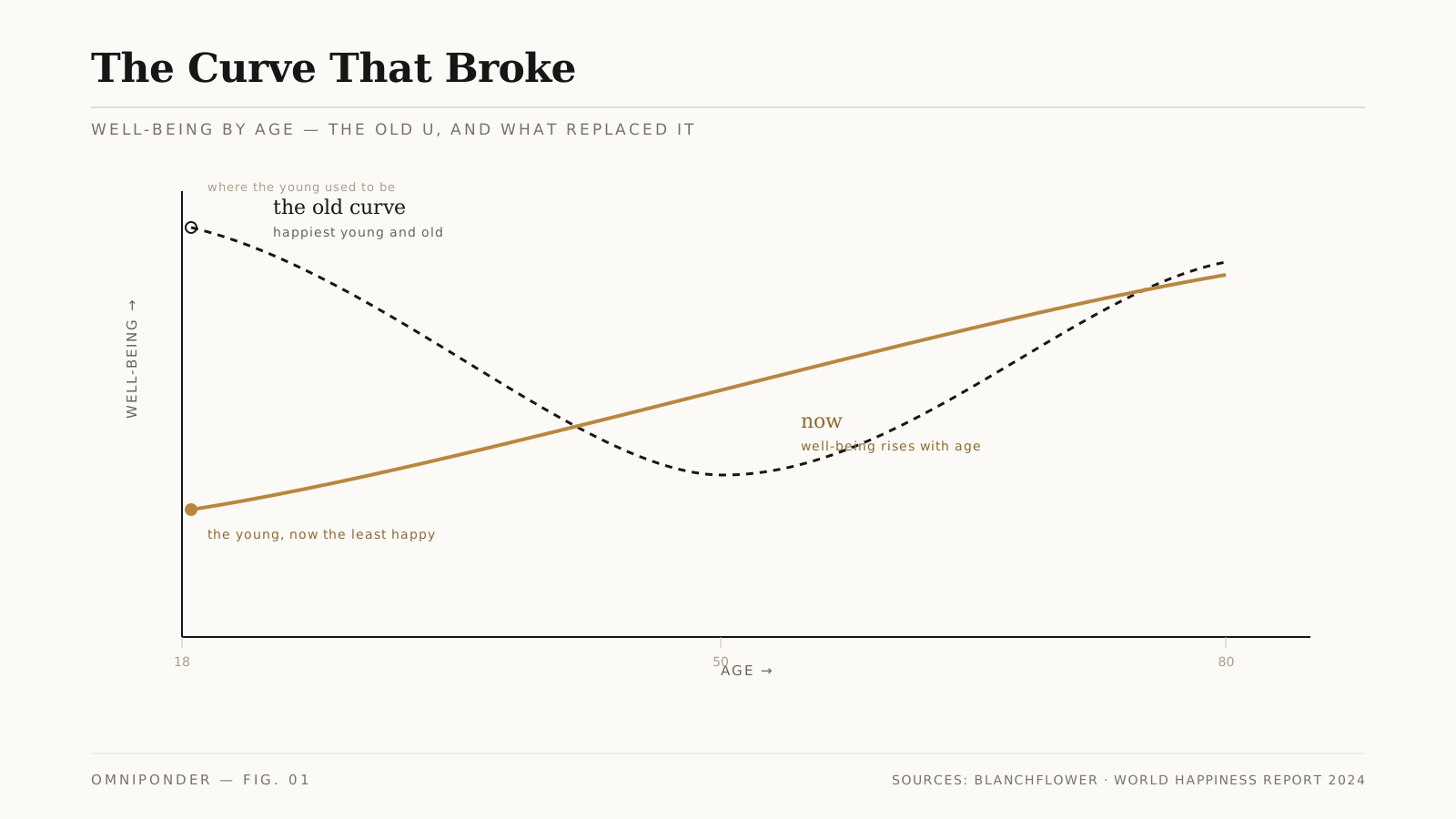 FIG. 01 — The shape social science relied on for half a century, and what has replaced it in much of the rich world. The young no longer sit at the top of the curve; they sit at the bottom. Sources: Blanchflower; World Happiness Report 2024.
The pattern that held everywhere
The old finding was not fragile, and that is exactly what makes its collapse so striking. The U-shape was not a single survey or a national quirk. Blanchflower's 2021 analysis of 145 countries found the same rise-fall-rise almost everywhere he looked, with a statistical low point around age forty-nine. Researchers argued about why it existed. Perhaps expectations set impossibly high in youth deflate in midlife and then recalibrate. Perhaps older people simply learn to want what they have. But the shape itself was not seriously in doubt.
Because it appeared across such different societies, many took the U to reflect something close to a natural arc of a human life, as if contentment followed a schedule written into the species. If that were true, the young would always occupy the happy upper-left of the curve, more or less by default.
The left side fell off
Then the young stopped cooperating with the theory.
Beginning around the middle of the last decade, the well-being of young adults started to fall, and it kept falling. The effect was sharp enough that the curve itself changed shape. In recent work, Blanchflower and colleagues report that the U has flattened or vanished in country after country, not because midlife improved but because the young collapsed toward it. Analyzing dozens of countries, they find that in much of the rich world happiness now tends to rise steadily with age, from a low among the young, with no upward-tilting left arm at all. By his estimate, roughly one in nine young women is now in a state his data classes as despair.
The most visible confirmation came from the 2024 World Happiness Report, which for the first time ranked countries by age group. The United States fell out of the report's top 20 for the first time since it began in 2012, dropping to 23rd, and the authors traced the decline squarely to a large fall in the well-being of Americans under 30. In the United States and across much of the Anglosphere, the young are now less happy than the old. The upper-left corner of the curve, once the most crowded, has emptied out.
Underneath the well-being surveys sit harder, more disturbing numbers. The U.S. Centers for Disease Control and Prevention runs a large biennial survey of teenagers, and its results show the share of high-school girls reporting persistent sadness or hopelessness rising from 36 percent in 2011 to 57 percent in 2021. Among boys the figure rose too, from 21 to 29 percent. These are not reports of a passing bad mood; the survey asks about feelings sustained for at least two weeks that interrupt normal activity. The pattern is worst among young women, and it shows up not only in what teenagers say but in behavior, including self-harm and emergency-room visits.
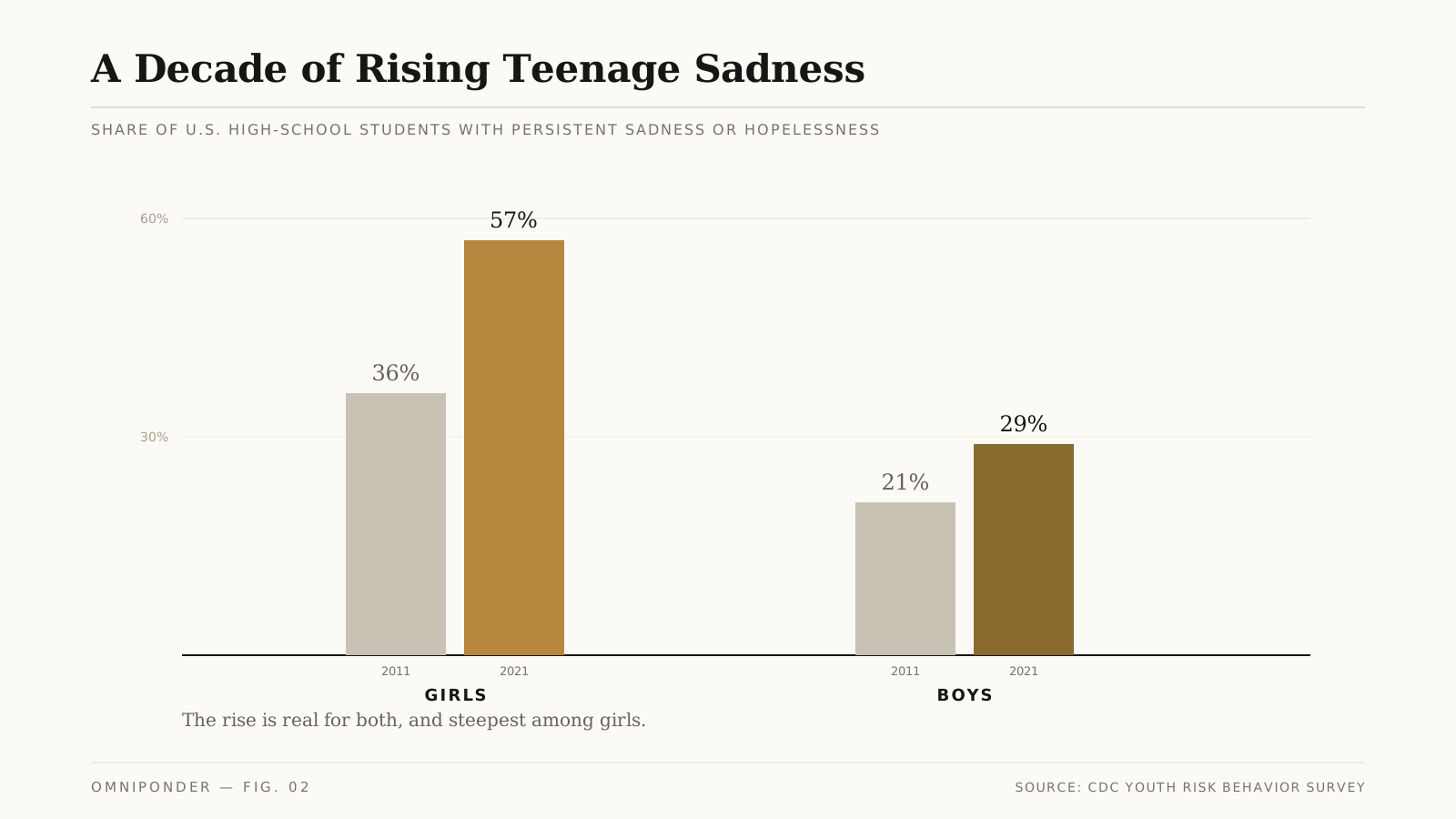 FIG. 02 — The share of American high-school students reporting persistent sadness or hopelessness, 2011 against 2021. The increase is real for both sexes and steepest among girls. Source: CDC Youth Risk Behavior Survey.
The prime suspect, and why the case is not closed
If well-being fell for a specific age group starting at a specific time, the obvious question is what changed at that time. One answer dominates the conversation, and its central piece of evidence is the timing.
The psychologists Jean Twenge and Jonathan Haidt argue that the culprit is the smartphone, and the social-media apps that came with it. The decline they describe begins around 2012 to 2015, exactly the window in which smartphones reached saturation among teenagers and the front-facing camera turned Instagram into a machine for social comparison. Haidt's 2024 book The Anxious Generation assembles the case: the collapse in adolescent mental health, he argues, is too sudden, too synchronized across countries, and too concentrated among girls to be explained by anything other than a rewiring of childhood around the screen. The timing is genuinely hard to wave away.
But timing is not proof, and here the honest account has to slow down. A large group of researchers who have looked directly for the damage report that they cannot find effects of the size Haidt describes. The psychologist Candice Odgers, reviewing the book in Nature, wrote that hundreds of researchers, herself included, have searched for large effects and found "a mix of no, small and mixed associations," almost all of it correlational. Andrew Przybylski and Amy Orben, analyzing very large datasets, estimated that digital technology use accounts for something on the order of a few tenths of one percent of the variation in young people's well-being, an effect they compared to that of wearing glasses. Correlation also runs both ways: unhappy teenagers may retreat into their phones rather than be made unhappy by them.
So the field is left in an uncomfortable position. The strongest argument for the phone hypothesis is the timing, which is striking. The strongest argument against it is the effect size, which in careful studies keeps coming out small. Both things are true at once, and a reader who wants an honest picture has to hold them together rather than pick the more satisfying one.
What else changed after 2012
The phone debate can crowd out a simpler possibility: that more than one thing changed, and that they compounded.
Loneliness is one thread. As screen time rose, the hours young people spent physically together fell, and by 2026 an eight-country study led by researchers at Washington University found that nearly half of young adults reported being lonely. Whether phones caused that retreat or merely filled the space left by it, the result is a generation spending less of its life in the same room as other people, and in-person connection is among the most reliable predictors of well-being that researchers have.
Economics is another. The young adults whose happiness fell are also the first cohort in living memory widely expected to end up worse off than their parents, facing housing costs that have outrun wages, insecure and fragmented work, and student debt taken on before they could judge its weight. The pandemic then landed on top of all of it, isolating adolescents at the exact age when peer contact matters most, though the decline had clearly begun years before 2020.
One more explanation deserves a fair hearing, because it would be reassuring: perhaps the young are not sadder, only more willing to say so, as stigma around mental health has fallen. There is probably something to this. But it cannot be the whole story, because the rise appears in behaviors that do not depend on self-report, and a change in vocabulary does not send more teenagers to hospital.
Why a young-least-happy world is different
It would be easy to file all this under the perennial worry that the kids are not all right, a complaint every older generation has made. That would be a mistake, because the specific thing that has changed is structural, not moral. The shape of a life's well-being has inverted at one end.
The old U-curve was, in its way, consoling. It said that unhappiness in the middle of life was normal and temporary, bracketed by better years on both sides. A world in which well-being instead begins low and climbs offers no such bracket to the young. The years when people are supposed to be forming the relationships, careers, and sense of self that carry them through the rest of life are now, on average, being spent under more strain than any other stage. Unhappiness at twenty is not the same as unhappiness at fifty, because it shapes the decisions, from work to marriage to whether to have children at all, that set the trajectory of everything after.
That is the real reason this matters beyond the individuals involved. A society whose young are its least happy members is running an experiment it has never run before, and the results will show up, with a lag, in its birth rates, its politics, and its capacity to trust.
We are, unusually, far more certain about the pattern than about its cause. The reversal is visible in national surveys, in the World Happiness Report, in clinical data, and across dozens of countries; it is not a statistical mirage. Why it happened remains genuinely unsettled, and the temptation to resolve that uncertainty with a single confident story, whether "it's the phones" or "it's a moral panic," is exactly the kind of shortcut a hard problem invites. The first task is the one adults find hardest: to accept that across nearly every instrument we have for measuring it, the young are telling us that something changed, and to take that seriously before we have the comfort of knowing why.