Tomorrow morning, at 7:26 Eastern, a Falcon Heavy is scheduled to lift off from the same Florida launch pad that once sent Apollo crews to the Moon. Its payload is a telescope built to study something that has never been seen, cannot be detected directly, and has no accepted explanation — and which happens to make up roughly seven-tenths of everything that exists.
The instrument is the Nancy Grace Roman Space Telescope. The something is dark energy. And the gap between how much of it there is and how little we understand about it is, arguably, the largest and most embarrassing hole in all of physics.
The 95 Percent Problem
Add up everything humanity has ever observed, catalogued, or touched — every star, every planet, every galaxy, every atom in your body and every atom in the sun — and you have accounted for less than five percent of the universe.
The rest divides into two mysteries.
- Ordinary matter — the stuff of the periodic table, of chemistry, of everything we have ever studied — is about 5% of the total.
- Dark matter, an unseen substance that outweighs ordinary matter roughly five to one and holds galaxies together, is about 27%.
- Dark energy, the force apparently pushing the universe apart, is the remaining 68%.
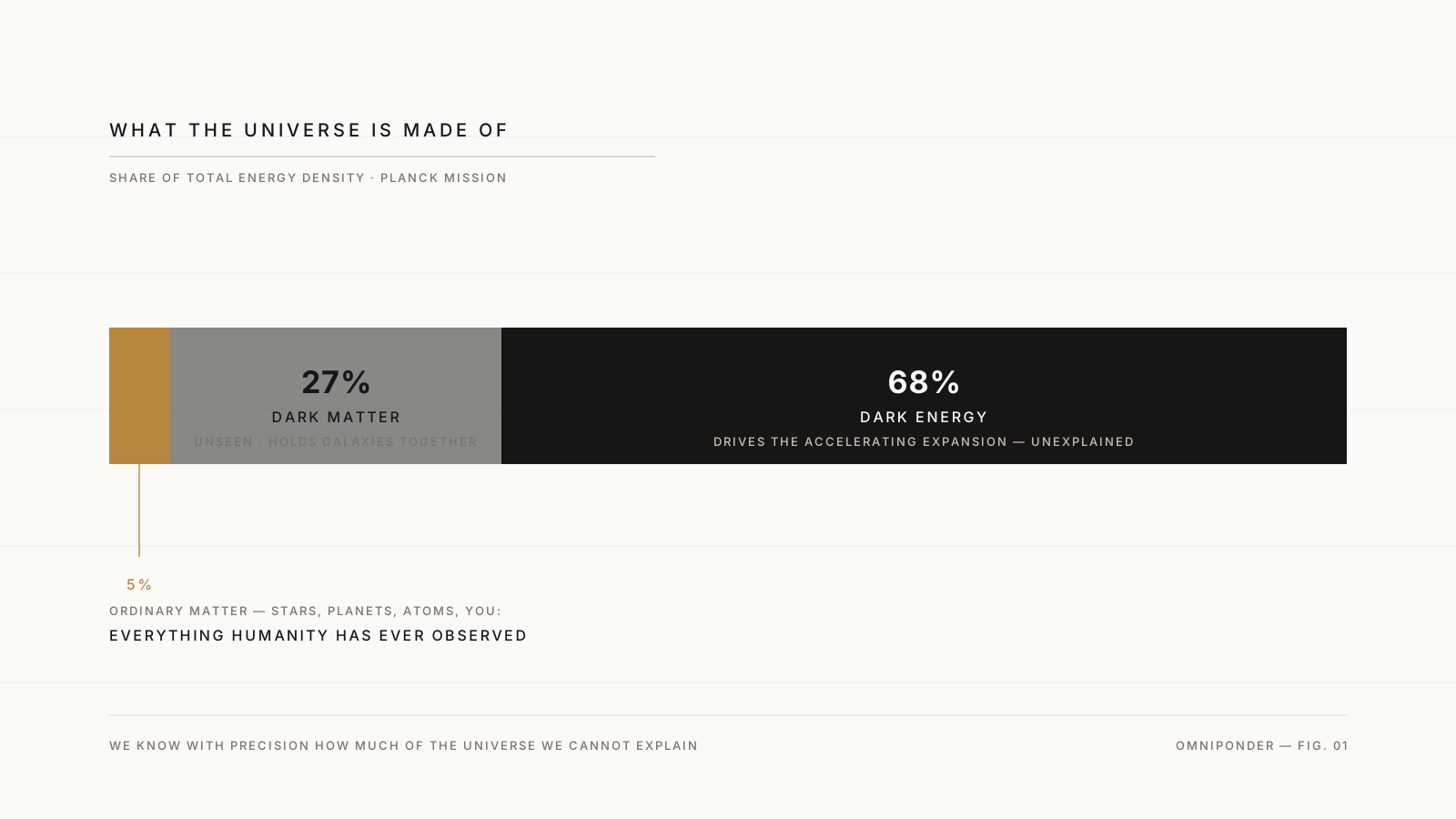 Caption: Everything humanity has ever seen or studied is the thin sliver on the left. The other 95 percent has no confirmed identity.
Those percentages, refined by the Planck spacecraft, are not rough guesses. They are among the best-measured numbers in cosmology. Which produces a strange situation: we know with real precision how much of the universe we do not understand. Naming the two dark components was not an act of discovery so much as an act of accounting — a label for a balance that would not otherwise close.
Dark matter is at least conceptually familiar: some kind of particle that has mass and gravity but does not interact with light. Dark energy is stranger. It is not a thing in space. It appears to be a property of space — of the vacuum itself.
How We Found Out the Sky Was Wrong
For most of the twentieth century, cosmologists assumed the universe's expansion, set in motion by the Big Bang, must be slowing down. Gravity pulls; matter attracts matter; the outward rush of everything should be gradually braking. The only open question was whether it would brake enough to eventually reverse.
In 1998, two rival teams set out to measure that deceleration precisely, using a particular kind of exploding star. A Type Ia supernova detonates at a consistent peak brightness, which makes it a standard candle: if you know how bright it truly is and measure how bright it appears, you know how far away it is. Collect enough of them at different distances and you can chart how the expansion rate has changed over cosmic history.
Both teams found the same thing, and neither wanted to believe it. The distant supernovae were fainter — and therefore farther away — than a decelerating universe could explain. The expansion was not slowing. It had, several billion years ago, begun to speed up.
The universe is not coasting to a stop. It is accelerating apart, and nothing in the known inventory of matter and energy should be able to make it do that.
The result was so unexpected that both teams spent months hunting for errors before publishing. There were none. The discovery earned the 2011 Nobel Prize in Physics, and it forced a placeholder into the equations of cosmology: some form of energy, woven into empty space, exerting a kind of negative pressure that drives expansion faster over time. That placeholder is dark energy.
Why This Is the Worst Prediction in Physics
Here is where the embarrassment becomes acute.
Physicists already had a candidate for an energy that fills empty space. Quantum field theory — one of the most successful frameworks ever devised, verified to extraordinary precision — says the vacuum is not truly empty. It seethes with fleeting activity, and that activity should carry energy. Empty space, in other words, should have an intrinsic energy density all its own. Einstein had even given it a name decades earlier, when he added a term called the cosmological constant to his equations.
So theorists did the natural thing: they calculated how much energy the quantum vacuum should contain, and compared it to the amount of dark energy actually observed.
The two numbers do not agree. They disagree by a factor of roughly 10 to the 120th power — a one followed by a hundred and twenty zeros. It is not a near miss to be tidied up later. It is the largest discrepancy between theory and observation in the history of science, sometimes called the vacuum catastrophe. Our best theory of the vacuum predicts an amount of dark energy so enormous it would have torn the universe apart before a single galaxy could form.
Something is profoundly wrong with how these pieces fit together. Either the vacuum energy is cancelled almost perfectly by some mechanism we have not found — cancelled to 120 decimal places, and then stopped — or dark energy is something else entirely, and our intuition about empty space is simply mistaken.
This is the problem Roman is being launched to attack.
What NASA Is Actually Sending Up
The Roman telescope has an unlikely origin. Its 2.4-metre primary mirror — the same size as Hubble's — did not begin life as a science instrument. It was surplus hardware from a repurposed reconnaissance satellite, handed to NASA by the National Reconnaissance Office. An eye built to look down at Earth has been rebuilt to look out at the universe.
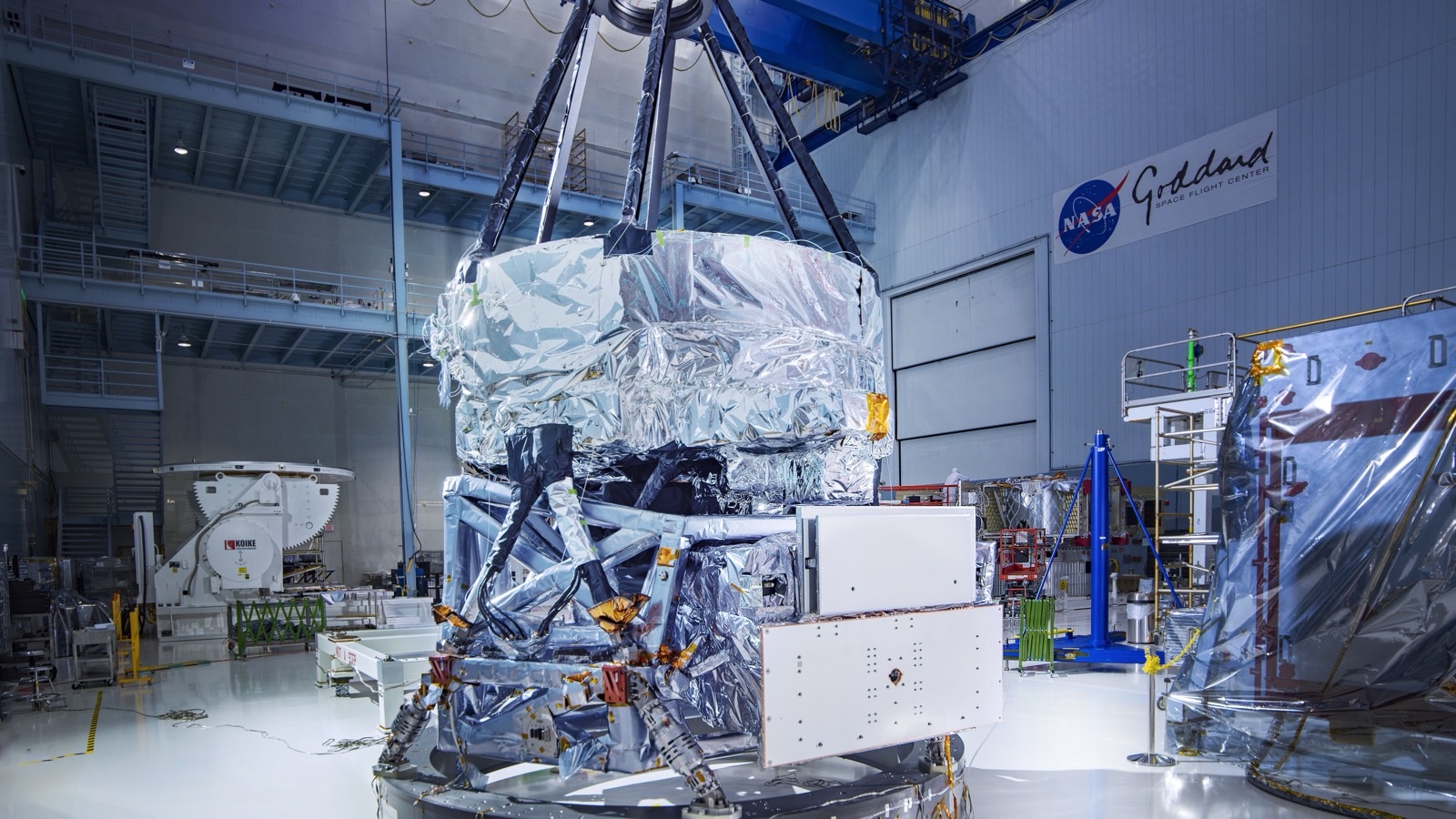 Caption: The Roman Space Telescope during assembly at NASA's Goddard Space Flight Center. NASA/Chris Gunn; public domain.
What makes Roman different from Hubble is not resolution but reach. Its field of view is at least a hundred times larger — a single Roman image captures a swathe of sky that would take Hubble a hundred exposures to cover. Over its mission it is expected to measure light from something on the order of a billion galaxies. It will operate not in orbit around Earth but at the second Lagrange point, roughly 1.5 million kilometres out, where it can stare into the dark without the Earth and Sun swinging constantly through its view.
That combination — enormous field, vast survey, stable perch — is what makes it a dark energy machine. To pin down a force this subtle, you do not need to see one thing sharply. You need to see almost everything, and measure it statistically.
Roman will do this three ways at once.
Standard candles. It will catch Type Ia supernovae across billions of years of cosmic time, extending the very measurement that revealed acceleration in 1998, with far more events and far greater precision.
Weak lensing. As light from distant galaxies passes massive clumps of dark matter, its path bends slightly, subtly distorting the shapes we see. By measuring these tiny distortions across a billion galaxies, Roman can map how matter is distributed and how that distribution has grown over time — and the growth of structure is exquisitely sensitive to dark energy's pull.
A cosmic ruler. In the infant universe, sound waves rippled through the hot primordial plasma and froze into a characteristic scale — the baryon acoustic oscillations — still faintly imprinted on the spacing of galaxies today. That fixed scale acts as a ruler laid across cosmic history, letting Roman measure how fast space has stretched at different epochs.
The Question Beneath the Question
All three methods converge on one deceptively simple question: is dark energy constant?
If dark energy is Einstein's cosmological constant — a fixed property of the vacuum — its density has been the same everywhere, always, and will drive an ever-faster, ever-colder expansion into a distant, empty future. But if its strength has changed over cosmic time, then it is not a constant at all but something more dynamic, and the entire standard model of cosmology needs revision. Recent large surveys have produced tentative, contested hints that it may indeed be evolving — not enough to claim a discovery, but enough to make the question urgent.
Roman is precise enough to tell the difference. That is the real stakes of tomorrow's launch: not a prettier picture of the cosmos, but a measurement that could either confirm the vacuum's constancy or break the model we have relied on for a quarter of a century.
There is something clarifying about the whole enterprise. We are spending years and billions of dollars, and firing a rebuilt spy telescope a million and a half kilometres into space, to study a thing we cannot define, using its faint effects on light that left its sources before the Earth existed. The honest description of the mission is that we are launching a machine to measure the exact shape of our own ignorance.
That is not a failure of science. It is what the frontier actually looks like. For most of history, not knowing what the universe was made of was a condition we could not even quantify. Now we can state it precisely — 95 percent unaccounted for — and build instruments specifically to close the gap. Tomorrow, one of them leaves the ground.