Open almost any economics textbook and you will meet the same short story, usually in the opening chapter. Once upon a time, before money, people bartered. A baker who wanted shoes had to find a cobbler who happened to want bread, and hope both agreed on the exchange. This was clumsy — economists call it the problem of the double coincidence of wants — so at some point clever humans invented money as a neutral medium of exchange, and commerce was freed to flourish.
It is a clean, logical, satisfying account. It is also, as far as anyone has ever been able to tell, false.
The story comes to us mainly from Adam Smith, who in 1776 described exactly this progression from barter to money as the natural history of trade. Economists have repeated it ever since. But for more than a century, anthropologists have gone looking for that original barter economy — the society that traded goods directly and then graduated to money — and they have never found one. As the Cambridge anthropologist Caroline Humphrey put it, no example of a barter economy that gave rise to money has ever actually been described. The founding myth of money describes a world that does not appear to have existed.
What the record shows instead is stranger, older, and far more interesting. Money did not begin as a thing you could hold. It began as a way of keeping track.
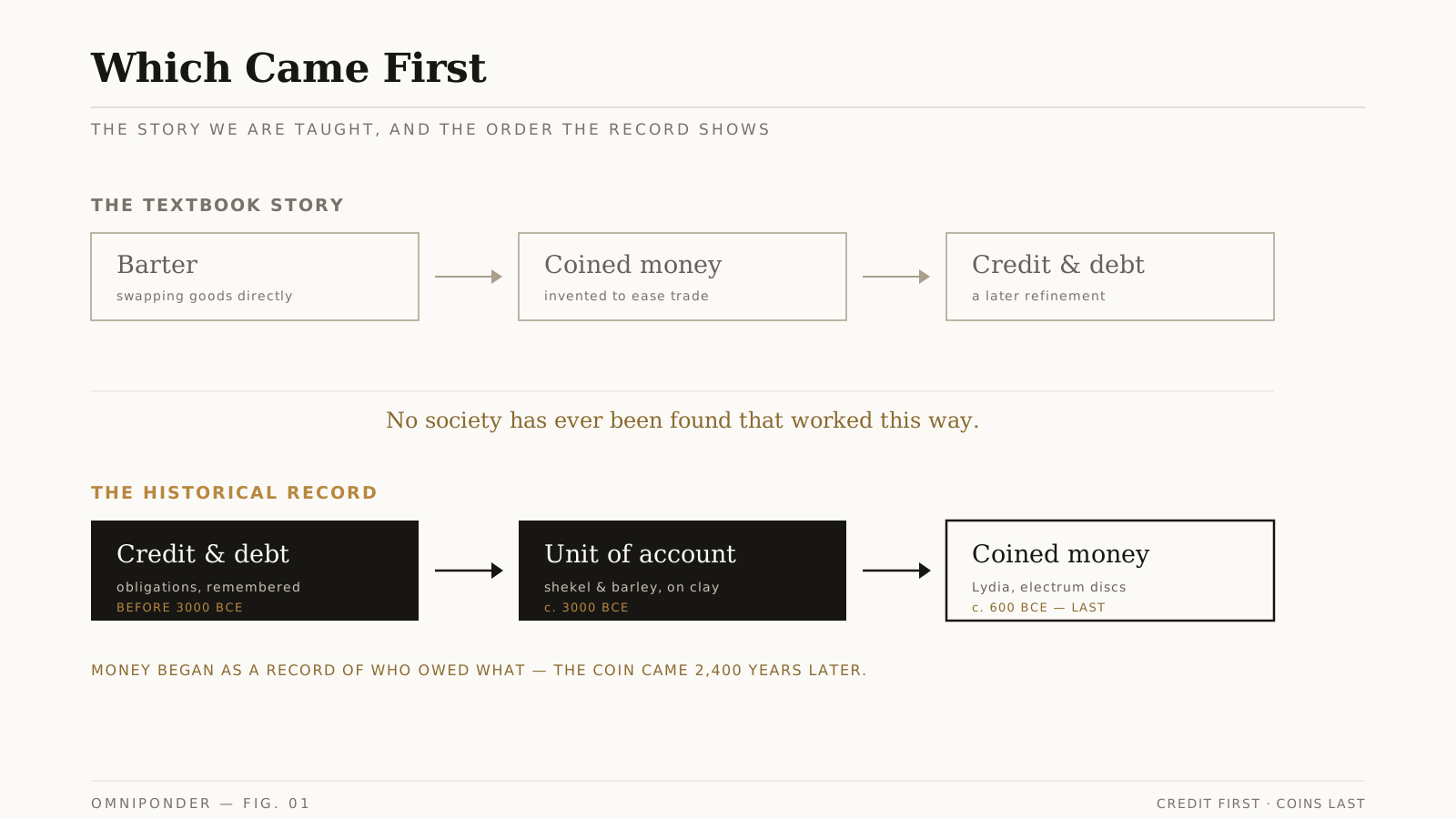 Caption: The folk history of money runs left to right along the top. The evidence runs the other way — credit first, coins last, roughly 2,400 years apart.
The Village That Never Existed
To see why this matters, it helps to notice what the barter story quietly assumes. It imagines strangers meeting to swap objects of equal value on the spot, each walking away owing the other nothing. That is not how small human communities have ever actually operated.
In societies without money, anthropologists find not barter but webs of credit and obligation. If you are a baker and your neighbor needs bread, you give them bread. It is understood, without a ledger, that they now owe you — not a specific loaf back, but a standing obligation to be settled someday, in some form, when you need something they can provide. Whole economies ran on this kind of remembered debt: gifts, favors, and running tabs held in the collective memory of people who expected to deal with one another for the rest of their lives. Direct barter did happen, but mostly between strangers or enemies — people with no ongoing relationship and therefore no trust to keep a tab open.
So the double coincidence of wants was rarely a real problem, because neighbors did not demand simultaneous equal exchange in the first place. They extended credit. The thing money supposedly solved was already solved, socially, by the simple human habit of keeping track of who had done what for whom.
That is the clue to what money really is. Before it was ever a coin, money was that keeping-track itself, made precise.
Debt Came First
The earliest documented money in human history is not a coin, a shell, or a lump of gold. It is a number written on clay.
In the temple and palace economies of Mesopotamia, some five thousand years ago, administrators faced a genuine accounting problem: how to record what farmers owed, what workers were owed, what had been deposited and lent and paid in rent. Their solution was a unit of account. Debts and holdings were denominated in standard measures — a weight of silver called the shekel, or an equivalent quantity of barley — and recorded on clay tablets. Crucially, the silver itself usually stayed in the temple. It was the yardstick, not the payment. Most obligations were settled in grain, labor, or goods; the money existed as the measure that made all those different things commensurable.
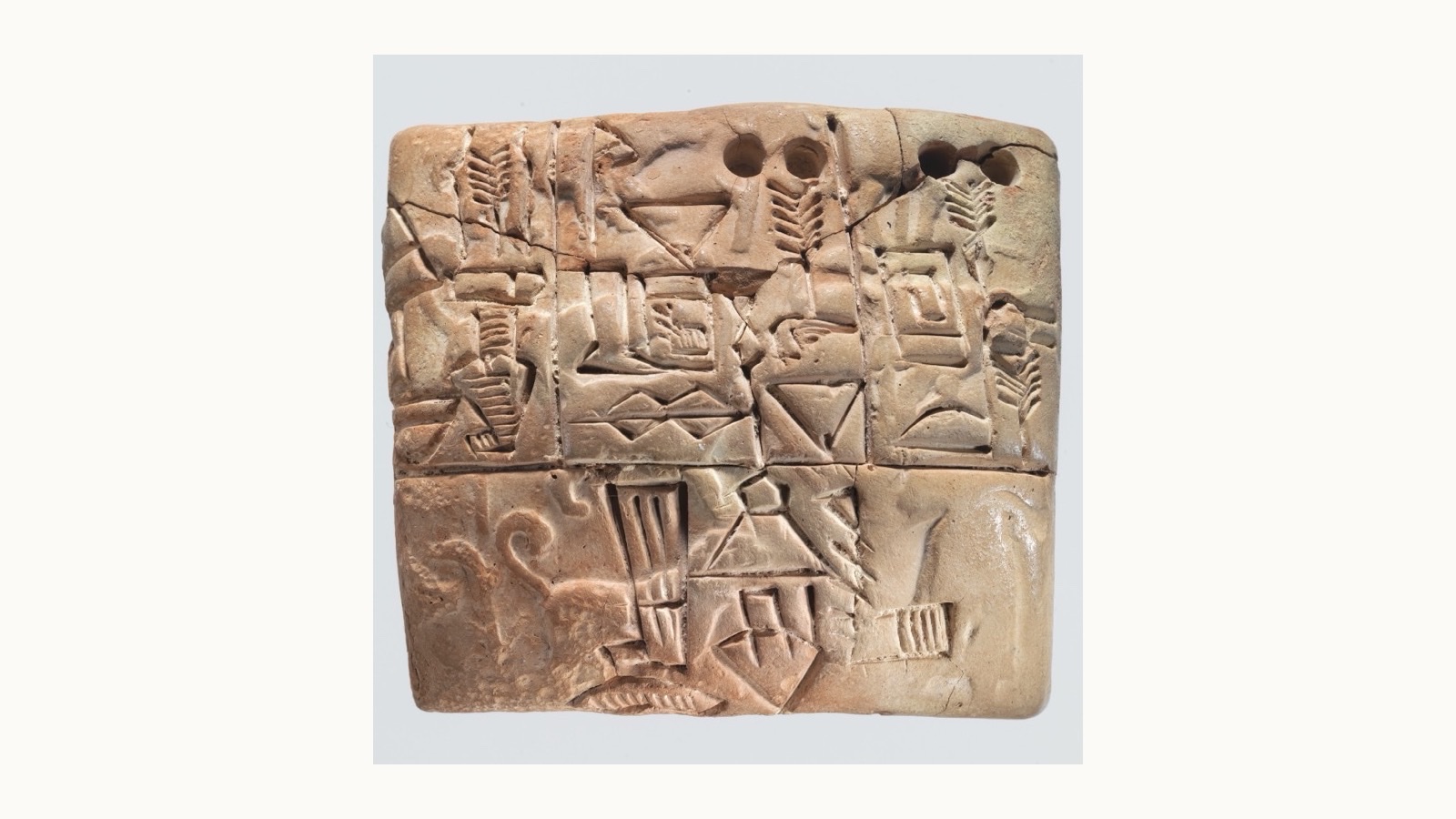 Caption: A cuneiform clay tablet recording an economic transaction, Mesopotamia. Records like these are the earliest known form of money — money as an account of who owed what. The Metropolitan Museum of Art, Open Access (public domain).
This is money as a ledger, and it predates coinage by roughly two and a half thousand years. It already had the features we think of as modern. There was interest: the economic historian Michael Hudson has noted that the Sumerian word for interest, mash, also meant a young calf — the idea being that lent money, like livestock, naturally bred more of itself. There was debt forgiveness, too; Mesopotamian rulers periodically declared clean-slate amnesties, cancelling the population's debts to prevent a permanent underclass of the insolvent. These are not primitive precursors to a money economy. They are a money economy — one built entirely out of credit and record, with no coins in sight.
Money, in its oldest and arguably truest form, is information: a durable record of obligation, denominated in an agreed unit, that a community treats as real.
Then Came Coins — and the State
Coins arrived late, and their story complicates the tidy picture even further.
The first true coins were struck in the kingdom of Lydia, in what is now western Turkey, around 600 BCE, from electrum, a pale alloy of gold and silver. And here is the puzzle: if money already worked perfectly well as temple credit, why stamp it into portable metal discs at all?
The most persuasive answer is that coinage solved a problem not of merchants but of states. A ruler with an army has to pay and provision tens of thousands of soldiers who are strangers, often far from home, with no relationship of trust to draw on. Credit does not scale to that. But hand each soldier a stamped coin, and then demand that every household in the realm pay its taxes in exactly those coins, and something remarkable happens: the whole population must now obtain the state's coins, which means feeding, clothing, and supplying the army in order to get them. The state has conjured a market into being around its own money, from the top down. This is the core of what economists call the state theory of money, or chartalism: money holds value because an authority issues it and demands it back.
On this account, coined money did not bubble up from villagers seeking a better way to barter. It was imposed from above, as an instrument of taxation and war, and the impersonal cash markets we treat as natural grew up in its shadow. The neutral medium of exchange in the textbook turns out to have been, at its origin, a technology of power.
What Money Actually Is
Pull these threads together and the folk story inverts completely. Credit came before cash. Accounting came before coins. And the state stood at the creation of money markets rather than arriving late to regulate them.
What remains, once the barter myth is cleared away, is a simple and slightly vertiginous idea: money is not a substance but a relationship. It is a socially maintained record of who owes what, backed by some authority — a temple, a king, a government, or a network — that the community trusts to keep the count honest. The coin in your pocket is not itself wealth; it is a portable, anonymous token of that ledger, a claim you trust others will honor because everyone else trusts it too.
Even gold, the substance that felt most solid, only ever worked this way. Gold has value as money not because you can eat it or build with it, but because a very long chain of people agreed to treat it as valuable. Its glow of permanence disguised the same social convention that underwrites a paper note. When the United States finally cut the dollar's last tie to gold in 1971, this did not corrupt money into something it had never been. It simply removed the metal costume and revealed what money had always, underneath, actually been: a promise.
Why the Origin Still Decides the Argument
This is not merely a correction to a dusty myth. It is why so many of today's fiercest financial arguments are really the same argument in disguise.
Consider the disputes that dominate the present. Cryptocurrency is, at heart, an attempt to build a ledger with no central authority keeping it — to replace trust in institutions with trust in mathematics and a distributed network. Central bank digital currencies are the opposite bet: the state proposing to keep the ledger more directly and completely than ever. The long argument over the dollar's role in the world, and whether other nations can escape it, is a question about whose promise the world is willing to hold. Each of these is a fight over who keeps the record and whose word you are prepared to accept.
The barter myth mattered because it made money feel apolitical — a neutral tool that markets invented for their own convenience, standing outside power and history. The real history shows the reverse. Money was entangled with authority, obligation, and trust from the very first clay tablet. It was never found lying in nature, waiting to make trade efficient. It was built, and maintained, and fought over.
That is the useful thing to carry out of five thousand years of evidence. Money was never a thing we discovered. It was a promise we learned to keep, and to enforce — and every upheaval in its history, from the first coin to the latest token, has been an argument about whom we are willing to trust to keep the count.