In the year 476, a commander named Odoacer deposed the last emperor of the Western Roman Empire. The emperor was a boy of about sixteen who bore, with almost unbearable irony, the names of Rome's founder and its first emperor at once: Romulus Augustulus, "the little Augustus." He was not killed. He was pensioned off to a villa on the Bay of Naples with a comfortable allowance, and Odoacer sent the imperial regalia east to Constantinople with a message that the West no longer required an emperor of its own.
The event we now enshrine as the Fall of Rome was noticed, at the time, by almost no one. There was no final battle for the ages, no single day the lights went out. A redundant office was quietly retired. Taxes were still collected the following spring; the Senate still met; people in Italy still thought of themselves as Romans and would for generations. If you had told the inhabitants of the empire that Rome had just fallen, most would not have known what you meant.
This is the first and most important thing to understand about how empires end. They do not fall the way we imagine — in a spasm of fire and invasion, brought low in an afternoon by a barbarian at the gate. They fall the way the writer's bankrupt character described going broke: gradually, and then suddenly. And the gradual part lasts so long, and feels so much like ordinary life, that those inside it almost never know what is happening to them.
The Myth of the Barbarian at the Gate
The popular theory of imperial collapse is a morality play. An empire grows rich, grows soft, grows decadent; its people lose the discipline and virtue that made them great; and then, weakened from within by their own excess, they are overrun by hardier peoples from outside. It is a satisfying story because it is a moral one, and because it hands us a lever: stay virtuous and you will not fall.
It is also, as history, largely wrong. Its most influential version comes from Edward Gibbon, whose monumental Decline and Fall of the Roman Empire, published as the American Revolution unfolded, blamed Rome's collapse on a loss of civic virtue and the enervating influence of Christianity. Gibbon was a magnificent writer and, on causes, a misleading guide. The moralizing frame has proven remarkably durable and remarkably useless, because it mistakes a symptom for a diagnosis and flatters the observer into thinking collapse is a punishment for identifiable sins.
Look closely at the "barbarians," and the morality play falls apart. By the fifth century, the Germanic peoples pressing on Rome's frontiers were not an alien horde storming a virtuous citadel. Many were already inside the empire — settled as federates, serving in the Roman army, sometimes commanding it. Odoacer himself was a soldier of Rome before he was its undertaker. The frontier peoples did not so much shatter the empire as move into a structure that was already failing to hold itself up. External pressure was the trigger. It is almost never the cause. The cause is whatever had already rotted the beams, so that a push which an earlier Rome would have shrugged off now brought the roof down.
Collapse Is the Price of Complexity
The most powerful account of what actually rots the beams comes not from a historian of Rome but from an archaeologist studying why complex societies fail in general. In 1988, Joseph Tainter proposed an explanation of collapse that has only grown more persuasive, and it begins with an unglamorous observation: societies are problem-solving machines, and their chief tool is complexity.
Faced with a problem — a hostile neighbor, a failing harvest, an unruly province — a society responds by adding complexity: a standing army, a bureaucracy, a tax system, a layer of administration, a network of roads and granaries. At first this pays handsomely. The early investments solve the easy, high-value problems, and the returns are enormous. But complexity has a cost, and the cost never goes away; every new layer must be fed and maintained in perpetuity. And because a society solves its cheapest problems first, each successive layer of complexity tends to solve a harder problem for a smaller return.
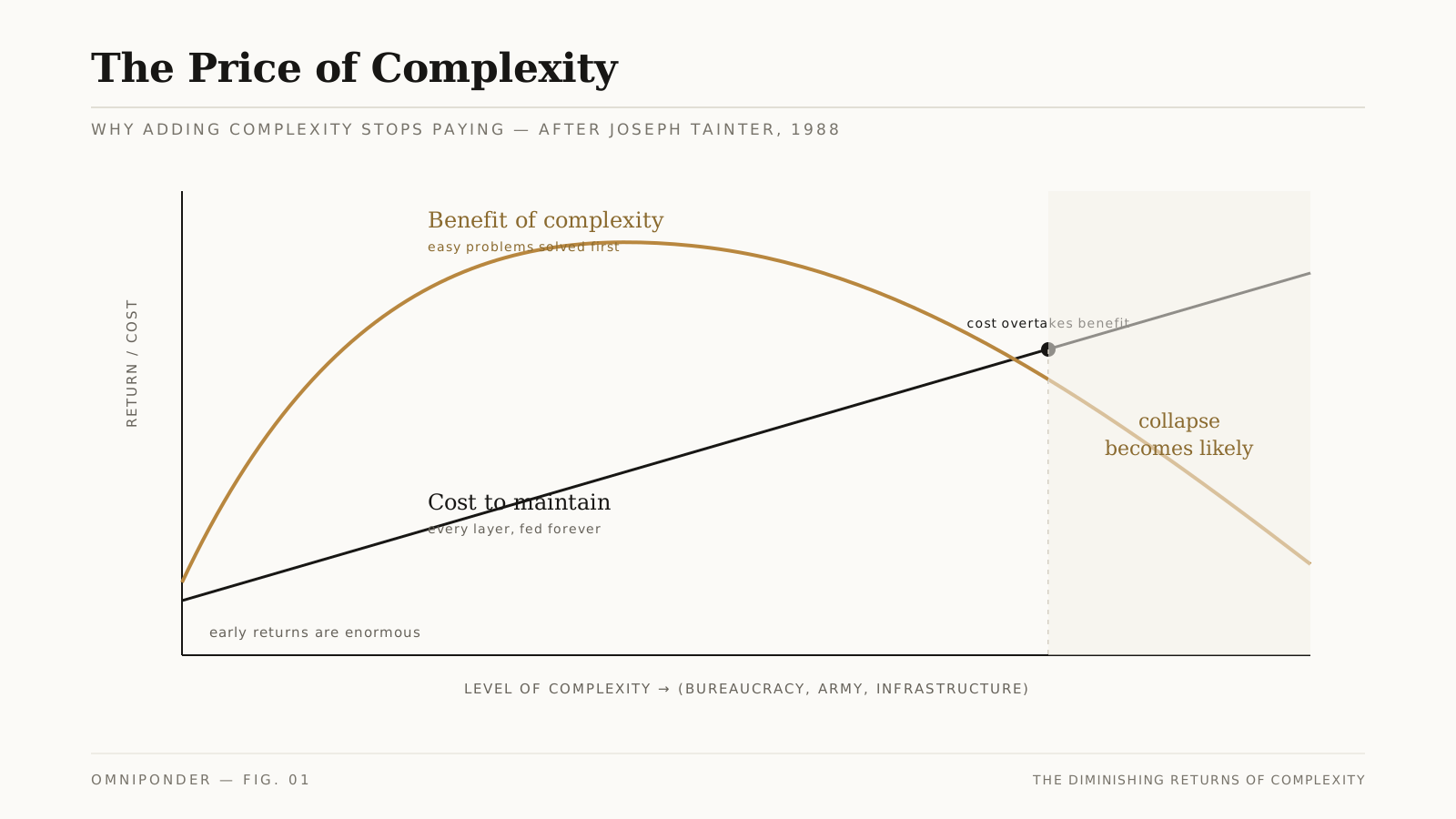 Caption: Complexity solves the easy problems first, so its returns diminish while its costs keep rising. When maintaining the apparatus costs more than it yields, collapse becomes, in Tainter's phrase, a matter of time.
This is the trap. Past a certain point, a society is running to stand still — pouring ever more resources into an apparatus that delivers ever less. The bureaucracy grows while governance worsens; the army grows while security shrinks; the taxes rise while the roads decay. And when the returns on complexity have gone flat or negative, the society has quietly lost its margin. It has no reserve of surplus, no slack, nothing held back for the bad year. A shock arrives — and now there is nothing to absorb it.
In that light, collapse is not a catastrophe imposed from outside so much as a rapid, involuntary simplification: the shedding of a complexity that could no longer pay for itself. Sometimes, Tainter argued, collapse is even the rational move — a return to a simpler, cheaper, more sustainable level of organization for the people who survive it. The empire does not so much die as get repossessed.
The Foundations That Erode First
If complexity is the slow disease, three foundations tend to give way beneath an empire in its terminal centuries, and Rome shows all three with brutal clarity.
The first is fiscal. An empire's reach is written in money, and Rome's money quietly failed. Across the third century, successive emperors, desperate to pay a swelling army, debased the silver denarius until it was mostly base metal with a wash of silver over it. The result was one of history's early experiences of runaway inflation, a currency that people increasingly refused to trust. A state that can no longer raise real resources from its economy cannot, in the end, defend or govern it, no matter how large it looks on a map.
The second is legitimacy. During the same third century, the empire nearly tore itself apart in what historians call the Crisis of the Third Century — roughly fifty years in which something like two dozen emperors rose and fell, the great majority murdered by their own soldiers or rivals. Whole regions broke away under their own emperors before being clawed back. An empire consumed by the question of who rules cannot attend to the business of ruling; every legion fighting a civil war is a legion not on the frontier. The center's authority, once it comes into doubt, becomes a resource that gets spent rather than renewed.
The third is the loss of adaptive capacity itself — the compounding effect of the other two. A state that is broke and politically unstable loses precisely the thing it most needs in a crisis: the ability to respond. The reforms of an emperor like Diocletian, who restabilized Rome around the year 300, tell the story exactly. He saved the empire by vastly expanding its army, its bureaucracy, and its tax burden — that is, by buying survival with still more complexity, and so raising the overhead that the next generation would struggle to pay. The cure and the disease had become the same thing.
Germs, Grain, and Weather
There is a further cause of collapse that the old moralizing histories could not see, because it lay beneath the reach of politics entirely. Recent scholarship, most strikingly the historian Kyle Harper's work on the Roman climate and Roman disease, has made a powerful case that Rome fell partly to forces of nature it could neither name nor fight.
Rome rose during centuries of unusually warm, stable, favorable climate — a long spell good for crops and for growth. That climate turned. A shift into colder, more erratic conditions in late antiquity, punctuated around the year 536 by a mysterious dimming of the sun now attributed to massive volcanic eruptions, brought failed harvests and hungry years to an empire already under strain. And into these stressed populations came pandemics of a scale the ancient world had never recorded: the Antonine Plague, the Plague of Cyprian, and later the catastrophic Justinianic Plague, an eruption of bubonic plague that may have killed a substantial fraction of the empire's people. An empire is, among other things, a population and a food supply. Sicken the one and wreck the other, and no amount of administrative genius will hold the structure together.
None of this replaces the political and fiscal story; it deepens it. A healthy, wealthy society with reserves can weather a plague or a cold decade. A society already running at the ragged edge of its complexity, with no surplus and no slack, meets the same shock and shatters. Nature did not fell Rome on its own. It applied the final loads to beams that were already straining.
Fall, or Transformation?
For all this, some of the best historians of the period would object to the very word "fall." A powerful school, associated with Peter Brown and the study of what he taught us to call Late Antiquity, argues that Rome did not so much end as change — that the centuries on either side of 476 show as much continuity as rupture, as the classical world slowly became the medieval one without ever experiencing a single moment of collapse. And there is the awkward fact that half the empire did not fall at all: the Eastern Roman Empire, ruled from Constantinople, endured for nearly another thousand years, until 1453.
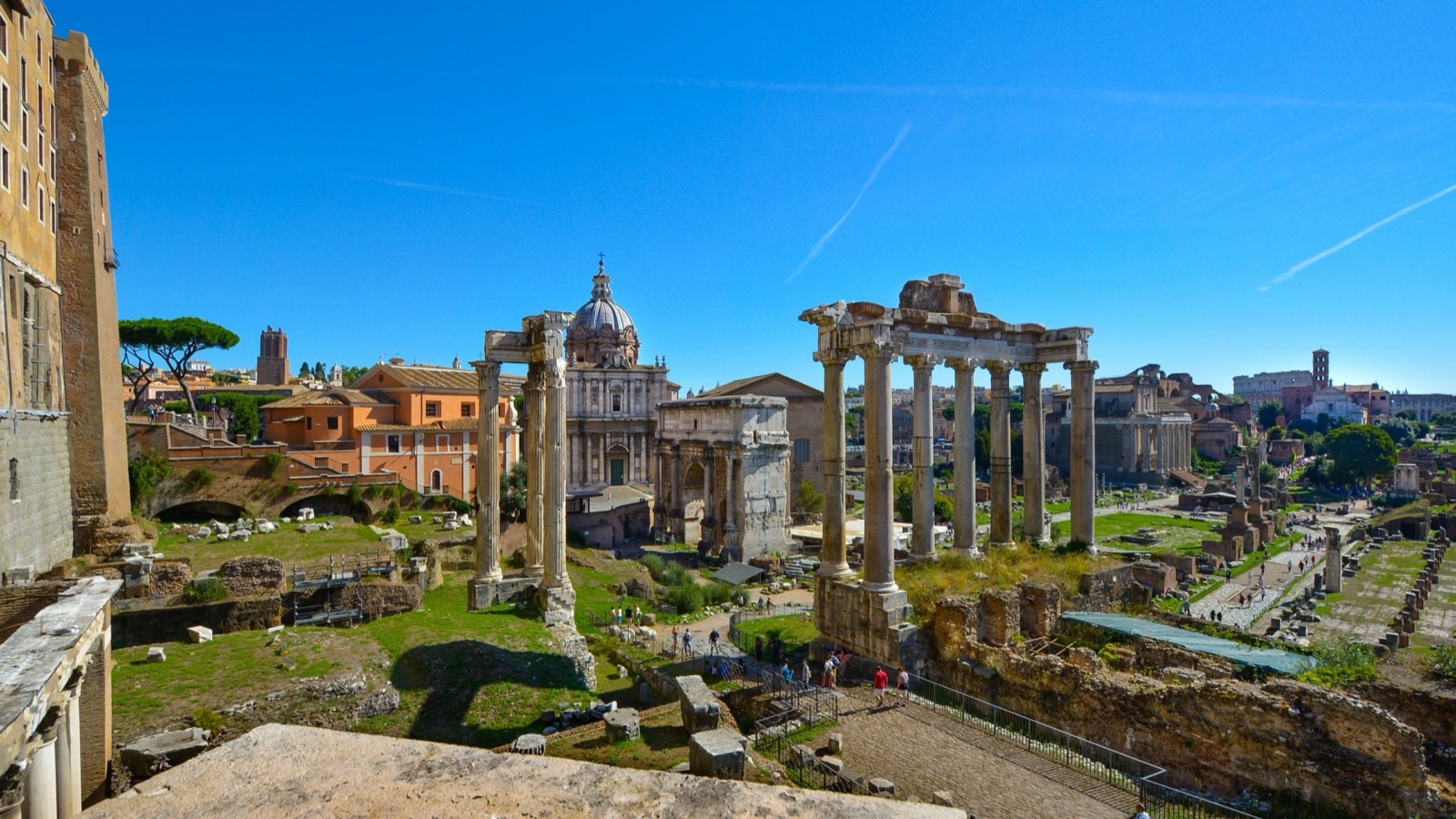 Caption: The Roman Forum today — the columns of the Temple of Saturn, the Arch of Septimius Severus, and, on the horizon, the Colosseum. What "fell" is, in fragments, still standing. Photograph by Kirk F; CC0 / public domain.
Others push back hard. The historian Bryan Ward-Perkins has insisted that for ordinary people in the former Western provinces, something real and terrible was lost — that trade contracted, cities shrank, literacy declined, and the material sophistication of Roman life genuinely collapsed, so that "transformation" can read as a scholar's euphemism for a fall that people at the time experienced as a disaster. Both are right, which is the point. Whether an empire "falls" or "transforms" depends on where you are standing, how long a view you take, and whether you are counting the continuities of culture or the collapse of the aqueducts. The end of an empire is not one event with one meaning. It is a change of state that looks different from every position inside and after it.
The View From Inside
Which returns us to the boy on the Bay of Naples, and to the strangest feature of the whole subject: collapse is nearly invisible from within.
It is invisible because it is gradual, and because each individual step down is small enough to seem like ordinary bad luck or a manageable adjustment. Taxes rise a little; the roads are repaired a little less often; the coinage buys a little less; the frontier is quiet, then not, then quiet again. No single year announces itself as the beginning of the end. People adapt, as people do, and their adaptation is precisely what keeps the decline from ever quite crossing the threshold of alarm. The generation that lived through Rome's third-century near-death did not know they were living in "the decline"; they were simply living, through hard times they expected to pass. Historical periods are named by the people who come afterward. No one has ever woken up knowing they live at the end of something.
This is the real warning that dead empires offer the living, and it is not a checklist of symptoms to watch for. It is an epistemological one. The instinct to look for a single dramatic cause of collapse — a decadence, an invasion, a villain, a date — is itself the error, because it trains us to watch for a spectacle that will never come while the actual process, slow and compounding and unglamorous, proceeds beneath notice. Empires do not fall because a barbarian appears at the gate. They fall because, over generations no one was tracking, they lost the capacity to pay for themselves and to adapt to what came next — and by the time the barbarian arrives, he is merely the last, small push against a structure that has been quietly hollowing for a hundred years. The fall is not the moment the wall is breached. The fall is the century of erosion that no one thought to call by that name.