For a few weeks each year, Kerala's commercial landscape becomes unmistakable. Gold retailers extend their hours. Appliance chains run their deepest discounts of the calendar. Onam is now the single largest consumption event in the state's economy, and the marketing around it is relentless enough to obscure what is actually being commemorated.
What is being commemorated is stranger than the advertising suggests. Onam is a harvest festival whose central emotion is grief, whose hero is a demon king, and whose plot turns on a god deposing that king not for cruelty or impiety but for governing too well. Beneath the floral carpets sits a story about a society without hierarchy, and about who found that society intolerable.
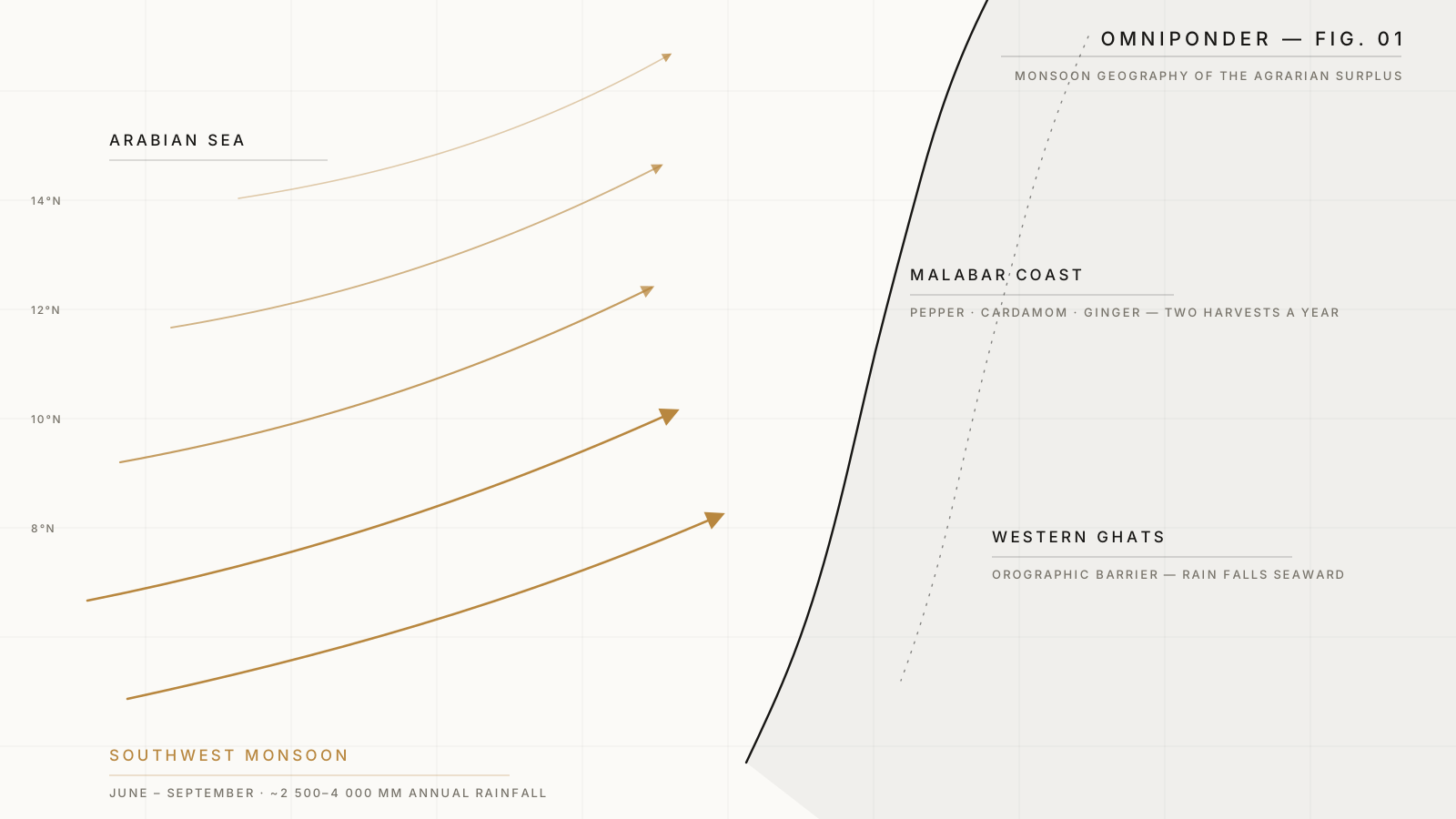 Caption: The Southwest Monsoon cycles that generated the agrarian surplus of the Malabar Coast.
The Geography of Wealth: Kerala's Monsoon Economy
No society holds a week-long feast without a reliable surplus. Kerala's came from a specific and unusually favourable arrangement of wind and rock.
Why the Southwest Monsoon Built a Surplus
The southwest monsoon arrives on the Malabar Coast around the first week of June and persists into September. It meets the Western Ghats, a near-continuous mountain wall running parallel to the shore, and is forced upward. Air cools as it rises, moisture condenses, and the seaward slope receives somewhere between 2,500 and 4,000 millimetres of rain a year — several times what falls on the plateau immediately behind it.
Two consequences follow, and both are economic.
- Reliability. The monsoon's arrival is variable by days, not by seasons. An agrarian society can plan around it, and planning is what converts good land into accumulated wealth.
- Two harvests. Sustained water in a tropical latitude permits a second annual rice crop where most of the subcontinent manages one.
- A spice monopoly. Black pepper, cardamom, and ginger require precisely the warm, wet, well-drained hill slopes the Ghats provide. For most of recorded history there was no substitutable growing region at scale.
- A navigable round trip. The monsoon reverses. A vessel could run east on the summer winds and return west on the winter ones — a predictable annual circuit, not a gamble.
That last point is easy to underrate. Long before European charts, the reversal made the Arabian Sea one of the most efficiently traded waters on earth. Greco-Roman merchants were exploiting it by the first century CE, and the archaeological record at the port of Muziris — Roman amphorae, coin hoards, a papyrus contract for a pepper cargo — describes a trade already mature. Pliny the Elder complained that the trade was draining Rome of specie — a complaint only a lopsided exchange produces.
The point worth holding onto is chronological. Kerala's wealth did not begin with the Portuguese. When Vasco da Gama reached Calicut in 1498, he arrived at a sophisticated, multi-ethnic commercial system perhaps fifteen centuries old and was received, accurately, as a poorly-provisioned newcomer. The European centuries changed who captured the rent. They did not create it.
That accumulated surplus is the material precondition for everything that follows. A festival of abundance requires abundance.
The History of Onam and the Legend of King Mahabali
Onam falls in Chingam, the first month of the Malayalam calendar, as the harvest comes in. Its story concerns Mahabali, an asura — a class of being conventionally rendered as "demon" and conventionally cast as the antagonist.
In his reign, the telling goes, there was no poverty. No disease. No deceit in commerce, no falsehood in speech, and — the detail that matters most — no distinction of caste or rank among his subjects. All were equal. The kingdom was, by the standards of every hierarchy that has ever existed, impossible.
The devas found this intolerable and appealed to Vishnu, who descended as Vamana, a dwarf brahmin, and asked the famously generous king for three paces of land. Mahabali granted it. Vamana then assumed cosmic scale, covering the earth in one stride and the heavens in the second, and asked where to place the third. Mahabali, having nothing left, offered his own head. He was pressed down into Patala, the underworld — and granted a single concession: permission to return once a year to see whether his people were still well.
Onam is that visit.
King Mahabali as a Critique of Hierarchy
Read as political philosophy rather than folklore, the structure of this story is remarkable.
In most mythological systems, divine intervention restores a moral order that a wicked ruler has violated. Here the inversion is total. The demon is virtuous. The king is just. The intervention comes from above and removes the good ruler — and the stated grievance is not tyranny but success. What threatened the gods was that a society had achieved equality and prospered under it.
The myth does not argue that hierarchy is natural. It concedes, in its own plot, that hierarchy had to be imposed — and that it required divine force to impose it.
This is why the festival's emotional register is nostalgia rather than triumph. Nostalgia directed at a political condition is never merely sentimental; it is an implicit judgment on the present. If the golden age was classless, the current age stands accused.
Comparable inversions exist elsewhere. Hesiod's Golden Age describes a lost era without toil or property disputes. The Roman Saturnalia licensed masters to serve their slaves for a day. But those are safety valves — temporary suspensions that reinforce the order they interrupt. Onam does something more demanding. It stages an annual inspection. The deposed egalitarian returns to verify that his people are still cared for, which means the community must present itself as worthy of him. Accountability is written into the ritual.
The persistence of this idea — that an equal society is not only imaginable but was once actual, and was taken away — is among the more durable features of political imagination. Understanding why the egalitarian myth recurs across unrelated cultures is exactly the sort of question about human nature that repays sustained attention.
The Mechanics of the Festival: Sadya, Cohesion, and Redistribution
The philosophy would be inert without machinery. Onam's customs function as that machinery.
The Onam Sadya is a vegetarian feast of twenty-odd preparations served in a fixed sequence on a banana leaf. Its significant feature is not the menu but the seating: participants eat on the floor, in rows, from identical leaves, receiving identical items in identical order. In a society historically organised around elaborate rules of ritual distance and commensality — who may eat with whom, and from what — a shared leaf is not a culinary convention. It is a temporary enactment of the equality the myth describes.
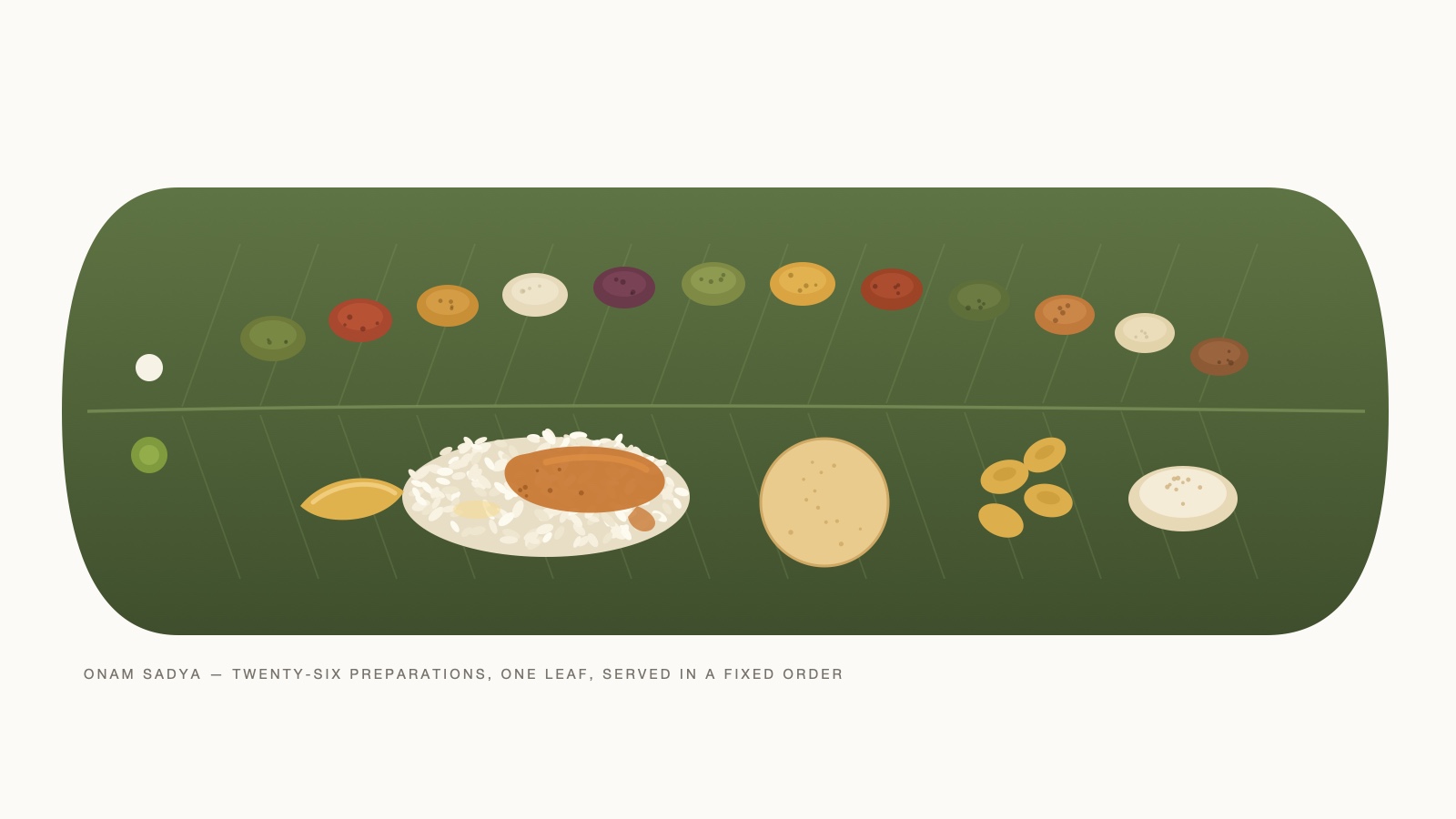 Caption: The cultural synthesis of the monsoon surplus, manifesting in the traditional Onam Sadya.
The distributive customs are more concrete still. Onakkodi, the gift of new clothes, moved from landholders to tenants, from employers to workers, from senior kin to junior. Provisions were advanced. Debts were, by custom, settled or deferred at Onam. The festival sat at precisely the calendar point where the harvest had landed and surplus existed to move.
Consider the underlying logic. Grain is perishable and storage is lossy; social obligation is neither. Converting a surplus into a feast and a round of gifts transforms a wasting asset into durable claims on future reciprocity — an insurance mechanism for a society with no formal one. Anthropologists have documented the same pattern in unrelated agrarian cultures, where large feasts operate as levelling institutions rather than displays of wealth.
The collective rituals do parallel work. Vallamkali, the snake-boat races, require crews of a hundred or more rowing in exact synchrony — a village-scale coordination exercise conducted as sport, in the season when coordinated labour is most needed.
The commercial Onam of gold advertisements is therefore not quite the betrayal it appears. A harvest festival was always about goods in motion. What has changed is direction. Surplus once travelled from those who held it toward those whose labour produced it. It now travels toward the retailer.
Still, the story is recited each year, and its content has not been softened. A society that annually rehearses the memory of a classless state — and stages the return of the king it lost — is keeping a question open that most political traditions prefer to close.