Earlier this month, scientists published the results of a strange and enormous experiment. They read the genomes of more than a million people, across forty-six studies and thirteen countries, and set them against one of the oldest questions we ask about each other: what are you like? Are you anxious or steady, curious or cautious, warm or guarded, driven or easygoing?
They found more than 1,200 places in human DNA that tilt a person one way or another along those lines. And then the finding turned quietly unsettling. Many of the same variants that nudge someone toward anxiety or openness also track things that feel like they should belong to biography, not biology — how much a person earns, how often they change jobs, how much time they will spend in a hospital bed over a lifetime.
It is the kind of result that invites two opposite panics. One is that our characters are written in our code, and the self we take credit for is mostly a readout of genes we never chose. The other, milder despair says the number itself is the cage: twelve hundred genetic variants steering us, so what room is left for a person to decide anything? Both reactions are natural. Both, read carefully, get the science exactly backwards.
The Oldest Question, Finally Measurable
That some of who we are arrives with us is not a new suspicion. Parents of more than one child usually abandon the blank-slate theory within a few years, watching temperaments they did nothing to install harden in the crib. The Victorian polymath Francis Galton coined the phrase "nature versus nurture" a century and a half ago precisely because the tension was already obvious.
What was missing was proof, and then a location. The proof came, across the twentieth century, mostly from twins. Identical twins share all their DNA; fraternal twins share half; and by comparing how alike each kind turns out, researchers can estimate how much of a trait's variation is heritable. The results were consistent and, to blank-slate hopes, deflating: for the broad dimensions of personality, something like 40 to 50 percent of the differences between people trace to genes. The most haunting evidence came from identical twins separated at birth and reunited as adults, who again and again described the same fears, the same humour, the same odd habits, as though a single script had been performed twice on different stages.
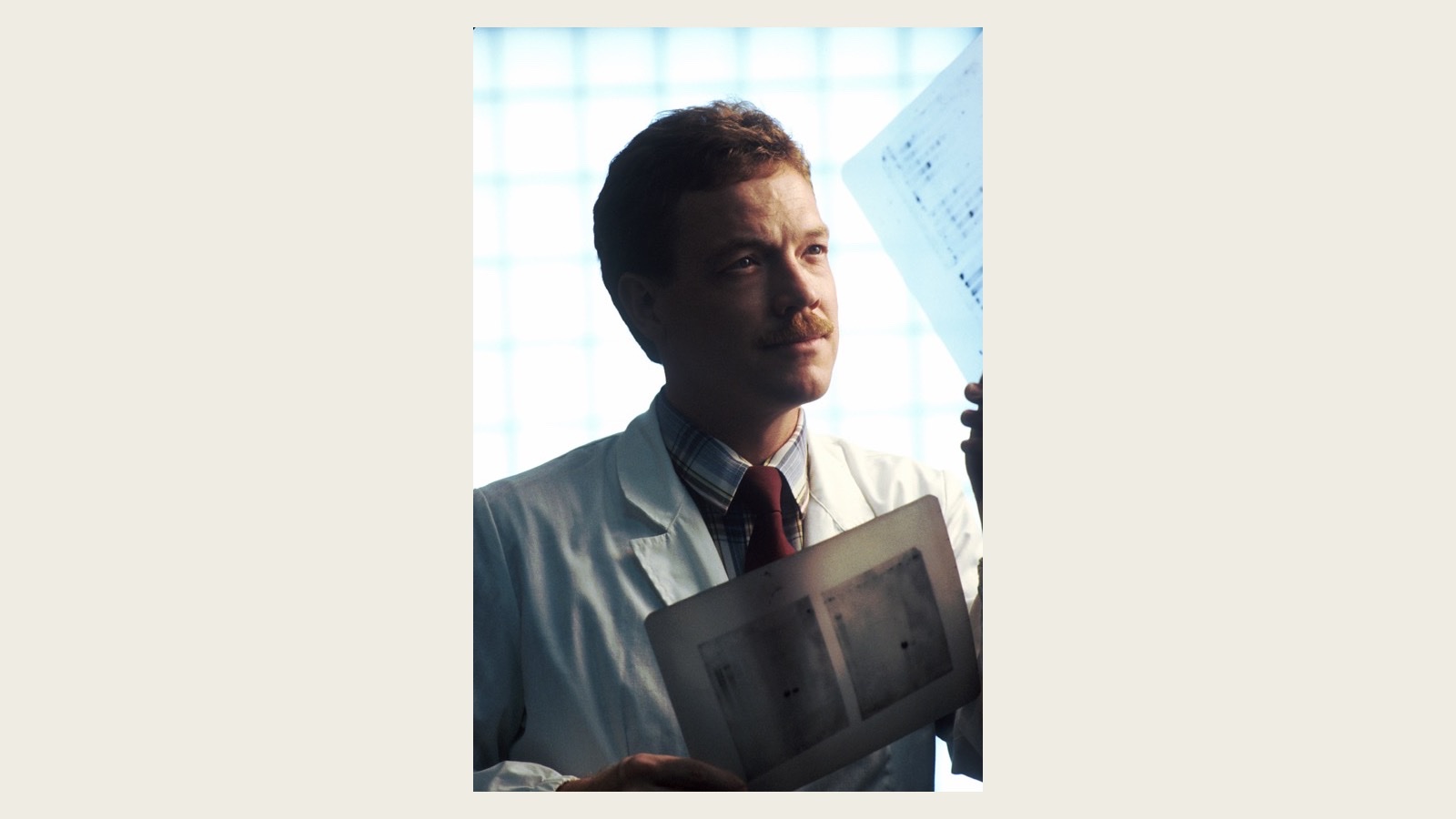 Caption: Reading DNA by eye in 1989. For decades the genes behind personality stayed invisible in images like these; it took a million genomes to find them. National Cancer Institute (John Crawford); public domain.
But knowing that personality was partly heritable told us nothing about where it lived. When gene-hunting began in earnest, the genes refused to appear. Studies would turn up a variant supposedly tied to neuroticism or extraversion, and it would explain a fraction of a percent, and it would fail to replicate. Twin studies insisted half of personality was in the DNA; the DNA itself seemed nearly empty. Behavioural geneticists gave the puzzle a name: the missing heritability. This month's study is, more than anything, the answer to where it was hiding.
There Is No Gene for Who You Are
It was hiding, it turns out, almost everywhere — in thousands of pieces, each so small it was invisible until the sample grew enormous.
This is the first thing the study actually shows, and it quietly destroys the entire genre of headline it will generate. There is no gene for extraversion. There is no gene for neuroticism, or openness, or any of it. What there is instead is a haze of more than a thousand variants per trait, each one nudging a person by a whisper — a hair's width toward talkative, a fraction of a degree toward worry — that only sums to something visible when you add up a million people. The effect of any single one, on any single person, is almost nothing.
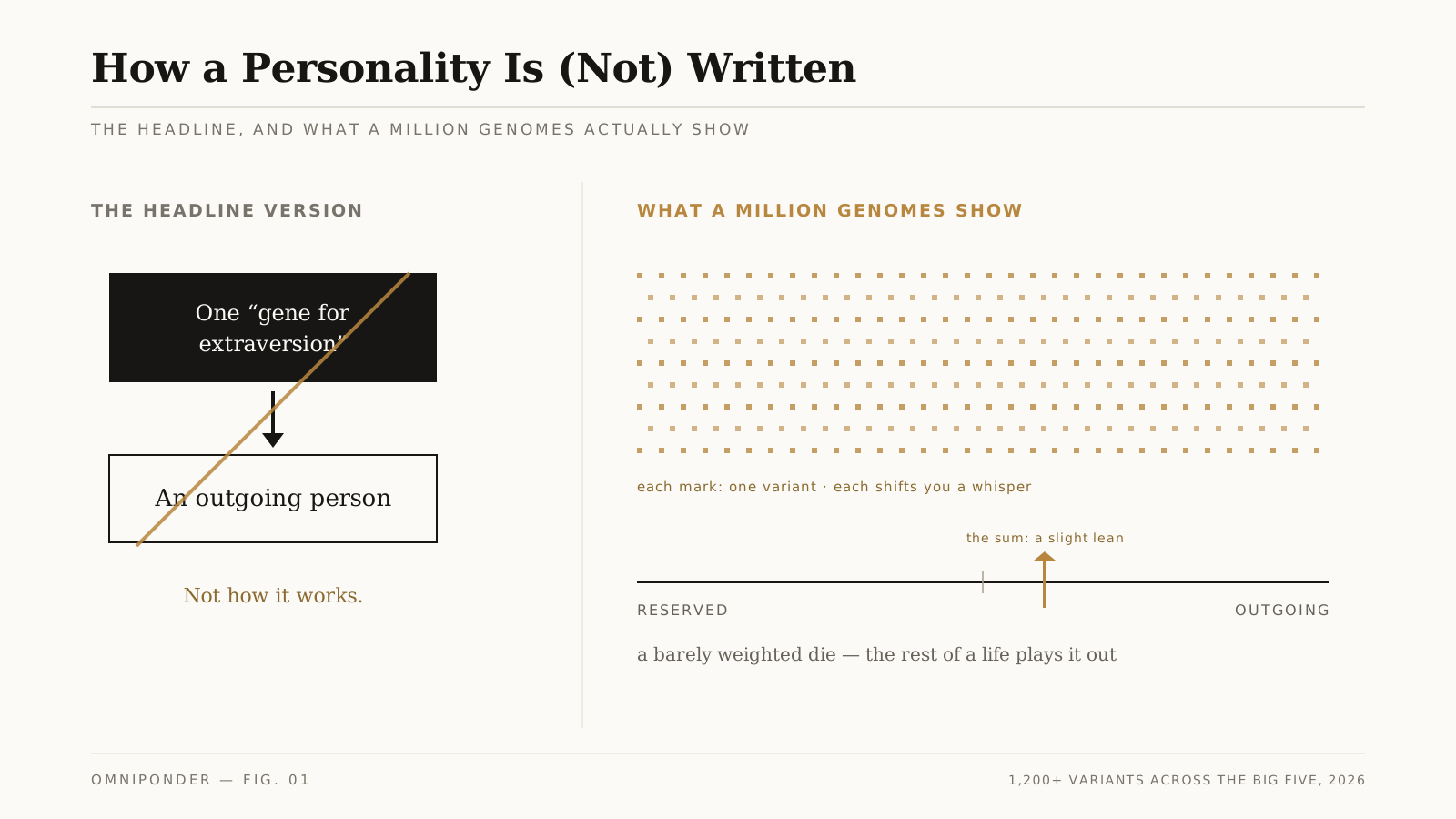 Caption: Personality is not switched on by a gene. It is the running sum of more than a thousand variants, each shifting you almost imperceptibly.
This matters because the shape of the answer changes its meaning. A trait produced by one powerful gene would be a kind of fate — present or absent, inherited like eye colour. A trait produced by the faint agreement of a thousand variants is something else entirely: not a switch but a lean, a barely weighted die, a slight and constant pressure that the rest of a life is free to confirm, resist, or overwhelm. Your character is not a note struck once at conception. It is a chord of a thousand almost-silent strings, and it still has to be played.
The Genes That Follow You Through Life
The genuinely disquieting part of the study is not the traits. It is that the same variants show up in your bank balance and your medical chart. Genetic tendencies toward neuroticism predicted more time spent in hospital; tendencies toward openness were linked to income and to changing careers. It looks, at first glance, like proof that the genome reaches past personality and into the whole arc of a life.
But look at how it would actually have to work, and the fatalism drains out of it. A genetic variant cannot deposit money in an account or book a hospital stay. What it can do is tip a disposition — and a disposition goes out into the world and chooses. A faint pull toward openness makes novelty a little more tempting, so a person takes the unfamiliar job, moves to the larger city, keeps looking; those choices, not the variant, move the income. A lean toward anxiety shapes ten thousand small decisions about risk and vigilance and rest, and those decisions, compounded over decades, leave their mark on a body.
Behavioural geneticists have a name for this loop: gene-environment correlation. Your genes influence the environments you seek, and those environments then shape you further, so that a tiny initial bias can grow into a settled trait by the simple mechanism of a life lived in its direction. This is the deep reason the old question — nature or nurture — was always malformed. It was never a contest between two forces. It is one feedback system: nature acting through nurture, a whisper at the start that recruits the world to make itself louder. The genes do not script the life. They tilt the earliest choices, and the choices do the rest.
The Temptation
None of this will stop the misuse, which is why the researchers built a warning into their own announcement. A genetic score for a personality trait is already technically possible; the study's co-lead, Michel Nivard, was blunt that these influences "do not determine who we become," and the team cautioned explicitly against using the findings to judge anyone for a job, a school place, an insurance policy, or a course of care.
The temptation is old and it has a dark record. The dream of reading character off the body — from the skull, the face, the blood, and now the genome — has always ended in the same place: treating a probability as a verdict, and a group average as a sentence on an individual. What makes the current version seductive is that it wears the authority of real, careful science. But the science, read honestly, refutes the misuse from the inside. The effects are minuscule. They are probabilistic, not deterministic. They are so entangled with environment that pulling the two apart for any single person is impossible. A polygenic score is a faint weather forecast for a life, not a photograph of a soul, and anyone who treats it as the latter has misunderstood the very finding they are citing.
The way to hold a number like this is with the humility the biology demands. It can tell you something true about populations and almost nothing certain about the person in front of you.
What Is Left of You
We approached this kind of research half-braced to be told that we are prisoners of our code, that the self is a genetic readout dressed up as a story we tell about our choices. The study says something closer to the reverse.
There is no finished person hidden in the genome, waiting to be printed. There is no master gene holding your temperament in trust. What the million genomes reveal is that heredity's grip on character is real but astonishingly diffuse — a thousand faint pressures, no one of which decides anything, all of them together amounting to a lean rather than a law. The rest is the environment those leanings drew you toward, the accidents no gene anticipated, and the long accumulation of what you actually did with the disposition you were handed.
You are not the twelve hundred variants. You are what a lifetime of choices, chances, and corrections made of them — which is to say you are the one thing the genome cannot supply, and never claimed to. It gave you a first inclination and then fell silent. Everything after that, you had to become.