A woman in her sixties arrives at the emergency room with crushing chest pain. Her electrocardiogram is abnormal in exactly the way a heart attack is abnormal. The blood test for cardiac damage comes back elevated. She is rushed to the catheterization lab, where a cardiologist threads a wire toward her heart, expecting to find a coronary artery clogged shut. The arteries are clear. There is no blockage anywhere. And yet the lower half of her heart has stopped squeezing and ballooned outward, so that the whole organ has taken on a strange, bulbous silhouette — wide and rounded at the bottom, pinched at the neck.
Then someone asks what happened to her today, and she says that an hour ago the phone rang and a voice told her that her husband had died.
This scene, in its essentials, plays out in cardiac units all over the world. It has a name — takotsubo cardiomyopathy, more plainly called broken heart syndrome — and its existence quietly demolishes one of the oldest condescensions in medicine: the assumption that "he died of a broken heart" was only ever a figure of speech.
A Metaphor That Turned Out to Be Literal
For most of modern medicine's history, the broken heart belonged to poets. Grief was understood to be real, even dangerous, but its danger was thought to be indirect — the bereaved sleep badly, drink more, forget their pills. The idea that sorrow itself could reach in and injure the muscle of the heart was treated as sentimental confusion, a category error made by people who did not understand anatomy.
That confidence was misplaced. In 1990, a Japanese cardiologist named Hikaru Sato described a cluster of patients whose hearts, in the middle of an apparent cardiac emergency, had deformed into an unmistakable shape. The bottom chamber bulged while the neck stayed tight, and the resemblance was so exact that Sato did not reach for a Greek anatomical term. He named it after a takotsubo — the round-bottomed, narrow-necked clay pot that Japanese fishermen sink to the seabed to trap octopus. A heart, caught and stunned, in the shape of a trap.
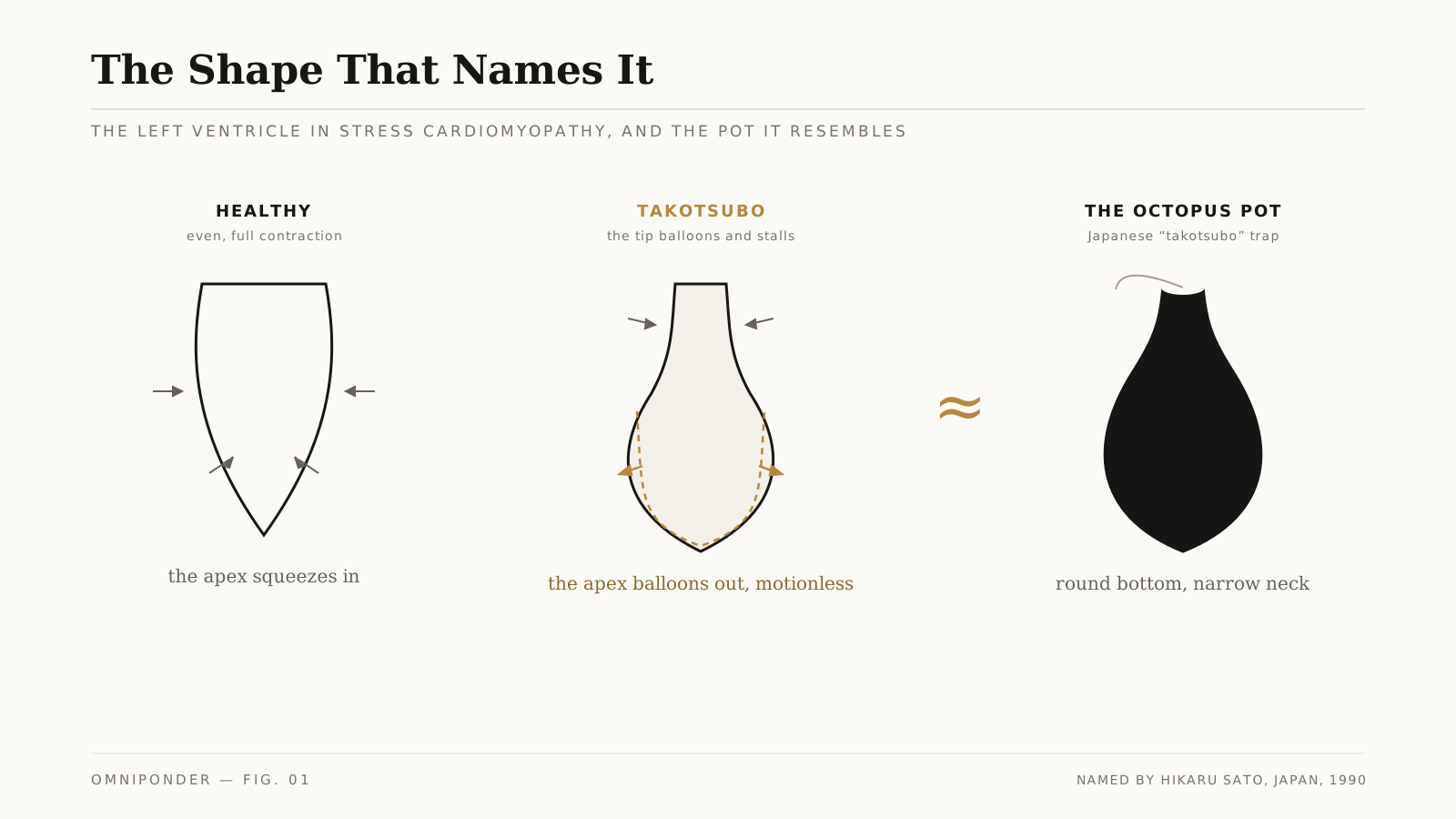 Caption: The name is a diagnosis. A healthy heart contracts evenly; in takotsubo syndrome the apex balloons into the shape of the octopus pot the condition is named for.
What makes the condition so philosophically disruptive is that it is a nearly perfect impostor of a heart attack. The chest pain is the same. The electrocardiogram shows the same ominous changes. The blood carries the same markers of a heart in distress. Every instrument agrees that a coronary artery must be blocked — and then the angiogram shows arteries that are open and clean. The heart is failing, dramatically, with no mechanical reason to. The only thing that has happened is that the person received a shock too large for the body to absorb.
The poets, it turns out, were being precise. We simply lacked the pictures to believe them.
What Actually Happens
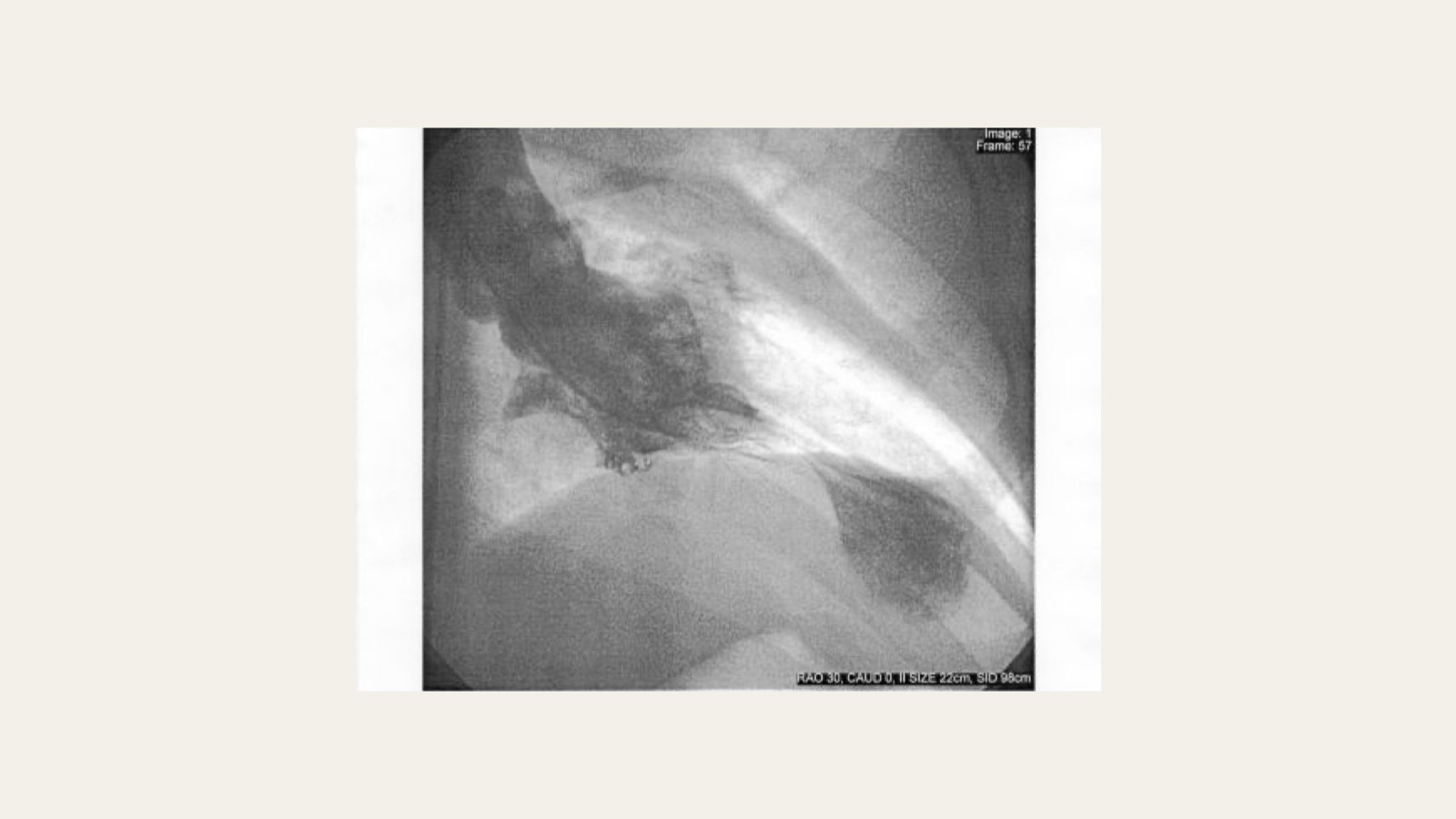 Caption: Not a diagram — an actual X-ray angiogram taken during an episode of takotsubo syndrome, the heart's apex ballooning as it fails to contract. Image: Olagoke Akinwande, Yasmin Hamirani & Ashok Chopra, CC BY 2.0.
The leading explanation for how an emotion becomes an injury runs through the body's oldest emergency system.
When the brain registers a sufficiently violent shock — terror, grief, rage — it triggers the sympathetic nervous system, the circuitry behind fight-or-flight, and floods the bloodstream with catecholamines: adrenaline and its chemical relatives. In ordinary doses these hormones are useful, sharpening the pulse and readying the muscles. In the doses released by a true catastrophe, they appear to become toxic to the heart itself. The current understanding is that this surge stuns the heart muscle directly and throws its smallest blood vessels into dysfunction, and that the lower tip of the heart, for reasons still debated, is unusually vulnerable to the assault. The muscle there essentially freezes mid-beat, and the chamber balloons.
It is worth being honest that this account is incomplete. Cardiologists can photograph the exact shape of the stricken heart, predict its rough course, and watch it recover, and they still cannot fully explain why the apex and not the base, why some people and not others, why a hormone the body makes on purpose should occasionally turn on the organ it is meant to protect. The condition sits on a frontier where a well-mapped emergency reflex does something no one has entirely accounted for. What is not in doubt is the pathway itself: a straight line runs from a piece of news the mind cannot bear to a physical deformation of the heart. The wall we like to imagine between the psychological and the physical has a door in it, and stress hormones are the key.
The Body Cannot Tell Joy From Grief
Here the story takes its strangest turn, and its most revealing one.
The same ballooning, the same trapped-octopus shape, has been documented after intensely happy events — a surprise birthday party, a wedding, a long-awaited reunion, a jackpot. Cardiologists have taken to calling this variant happy heart syndrome, and it is not a curiosity so much as a clue. If both the worst news of a life and the best can stun the identical patch of heart muscle, then the body is not responding to sadness. It is responding to intensity.
The physiology does not read the meaning of an event; it reads only the size of the arousal. Joy and grief, so opposite to the mind, arrive at the heart as the same thing — a surge too large to buffer. There is something humbling in that. We experience our emotions as finely distinguished, a whole vocabulary of feeling, and at the level of the machinery that keeps us alive, the vocabulary collapses into a single dimension: how much. The heart can be overwhelmed by love as surely as by loss, because to the ancient alarm system that governs it, both are simply too much.
Who It Breaks
The condition is not evenly distributed. Roughly nine in ten cases occur in women, the great majority of them past menopause — and that pattern points back, again, at chemistry. Estrogen appears to shield the heart from catecholamines and to soften the body's whole stress response; as its levels fall after menopause, that protection seems to lift. The folk record ran ahead of the science here too. The image of the widow who dies within weeks or months of her husband, long treated as a sad coincidence or a poetic tidy ending, describes a real and now partly explained phenomenon.
But the numbers carry a hard corrective against sentimentality. A recent American Heart Association analysis of nearly 200,000 U.S. patients found that broken heart syndrome killed about 6.5 percent of them in the hospital, with a battery of serious complications — heart failure in more than a third, dangerous rhythms, stroke, cardiogenic shock — and, sobering everyone who studies it, no improvement in those outcomes across the years measured. There was also a cruel inversion buried in the data: although women develop the condition far more often, the men who develop it die at more than twice the rate. A broken heart, it turns out, is most common in the grieving widow and most lethal in the man no one expected it to touch.
This is the part the tender name obscures. Takotsubo syndrome is usually survivable, but it is a genuine cardiac emergency, and sometimes the heart that grief has stunned does not restart.
The Heart Re-forms
And yet its final strangeness is a kind of mercy, and it is what separates this injury from almost every other.
A true heart attack leaves scar — dead muscle that never beats again, a permanent subtraction. Takotsubo syndrome, in the great majority of cases, does not. Within days to a few weeks, the ballooned chamber deflates, the frozen muscle wakes, and the heart returns to its ordinary shape as though nothing had happened. Around ninety percent of patients recover fully. The organ that was deformed by feeling re-forms.
There is no need to sentimentalize this to feel its weight. Here is a condition in which the heart is quite literally broken by what the mind cannot withstand, is shown on film to have lost its shape, and then, given time and survival, mends itself back to what it was. The metaphor and the mechanism have become the same object. Hearts break; the imaging proves it. Hearts also heal; the follow-up scans prove that too.
For centuries we kept two accounts of the heart and assumed only one was true. There was the pump — the muscular, four-chambered fact of cardiology — and there was the heart of language and song, the seat of love and grief, which educated people understood to be a beautiful fiction laid over the machinery. Takotsubo syndrome is the point where the two accounts touch. It says that the heart of the poets and the heart of the physicians were never separate organs. The thing in your chest can be stopped by sorrow and quickened by joy and, on rare and dangerous occasions, brought to the edge of failing by either. We built our most advanced machines to look inside it, and what they found, in the end, was the oldest human intuition of all — waiting there in the shape of a trap, and then, quietly, letting go.