A blockade used to be an announcement. A state declared it, stationed ships, and accepted that it had committed an act of war. The legal architecture built around that assumption — codified through the nineteenth century and refined after it — presumed a blockade was visible, attributable, and enforced by hulls.
That presumption was load-bearing. The Declaration of Paris in 1856 held that a blockade was binding only if it was effective — meaning maintained by a force genuinely sufficient to prevent access. The rule was not humanitarian sentiment; it was a practical constraint that made blockade expensive, visible, and therefore rare. A state that could not sustain the ships could not claim the right.
None of those three conditions holds any longer. The most consequential interference with global trade now arrives without declaration, without attribution, and frequently without a warship anywhere in the vicinity. It arrives as a dragged anchor at two hundred metres, or as a missile costing less than the interceptor fired to stop it.
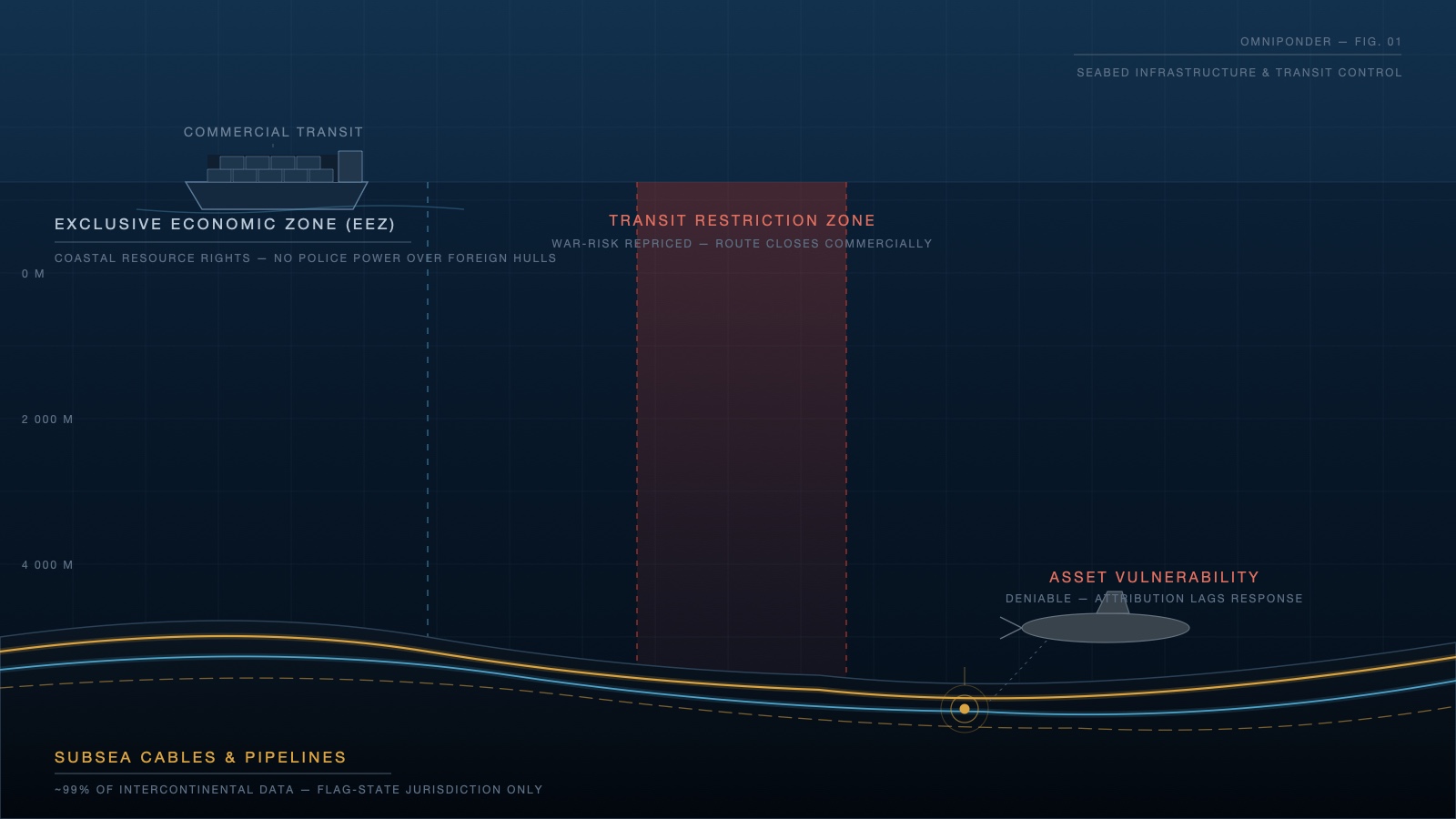 Caption: The convergence of invisible seabed infrastructure, maritime law, and modern asymmetric naval force.
The Blockade That Does Not Declare Itself
The Red Sea disruption that began in late 2023 was instructive out of all proportion to the tonnage actually struck. A non-state actor with a modest inventory of drones and anti-ship missiles achieved what a conventional blockade would have required a fleet to attempt: the effective closure of a primary artery of world trade, sustained across months.
The arithmetic is what matters. Interdiction was attempted with munitions costing thousands to low hundreds of thousands of dollars. Defence frequently demanded interceptors an order of magnitude more expensive, launched from warships carrying finite magazines that cannot be replenished at sea. A defender can prevail in every individual engagement and still lose the campaign on cost.
The modern blockade does not need to sink ships. It only needs to make the route expensive enough that the market closes it voluntarily.
The Insurance Mechanism
This is where the actual enforcement happens, and it is not military. War risk premiums are the transmission belt between a threat assessment and a shipping decision. When underwriters reprice a corridor, charterers reroute — and the strait is closed in every practical sense without a single shot connecting.
The implication is uncomfortable for anyone designing deterrence. A credible threat performs most of the work of an actual attack. That inverts the traditional calculus, in which a blockading power had to commit forces and accept escalation risk. The new version is cheap, deniable, and enforced by actuaries in London rather than by admirals at sea.
The Infrastructure Nobody Governs
The surface story is the visible half. The more serious exposure lies on the seabed.
- Roughly 500 submarine cable systems carry close to 99 percent of intercontinental data traffic. Satellites handle a rounding error by comparison.
- Those cables underwrite the settlement of financial transactions measured in trillions of dollars daily — clearing, messaging, and market data all ride the same glass.
- The world sustains on the order of 150 to 200 cable faults a year, the overwhelming majority accidental: anchors, trawlers, seabed movement.
- Repair depends on a specialised global fleet numbering only a few dozen vessels, much of it ageing, with regional coverage that is thin in precisely the places where tension is highest.
That last figure is the one that should attract attention. The system tolerates routine damage because repair is routine. It has never been tested against damage that is deliberate, simultaneous, and concentrated.
The same logic extends to energy. Subsea pipelines are fixed, mapped, unarmoured, and — as the Nord Stream ruptures in 2022 and the Balticconnector damage in 2023 demonstrated — reachable by anyone with a capable vessel and a reason.
Where the Law Runs Out
The governing framework is thinner than the stakes suggest. The United Nations Convention on the Law of the Sea obliges states to criminalise the breaking or injury of submarine cables by vessels flying their flag or by their nationals — a provision inherited almost verbatim from an 1884 convention written for telegraph lines.
Three gaps follow directly.
Jurisdiction is flag-based. Beyond the territorial sea, a coastal state generally cannot board or prosecute a foreign vessel for damaging a cable crossing its exclusive economic zone. An EEZ conveys resource rights, not police powers over foreign shipping. Enforcement depends on the flag state — which, where the flag is one of convenience or the actor is a proxy, means enforcement depends on the party least motivated to enforce.
Penalties are trivial. The offence was drafted as negligence by a commercial operator, not as sabotage by a state instrument. The sanctions available bear no relationship to the damage a deliberate multi-cable cut would inflict.
Deniability is structural. An anchor dragged across a cable corridor is indistinguishable, on the available evidence, from an anchor dragged by accident. Attribution requires forensic seabed work, cooperative flag states, and time — and the standard of proof needed for a legal or military response is far higher than the standard needed to create the disruption. The International Cable Protection Committee has pressed this point for years, largely without regulatory result.
The pattern is already visible in miniature. The cables serving Taiwan's Matsu Islands have been severed repeatedly, leaving a population of thousands dependent on constrained microwave backup for weeks at a stretch while a repair vessel was located and scheduled. Each individual incident was survivable and each was formally unattributed. The demonstration value lay precisely in that combination.
The seabed is the only critical infrastructure in the world protected chiefly by the assumption that no one will bother to attack it.
The Repair Bottleneck
Even absent a legal fix, capability would matter. Repair ships are few, slow to build, and require trained crews and cable stock. A state contemplating disruption is not weighing whether a cut can be repaired; it is weighing how long the repair takes and how many simultaneous cuts the fleet can absorb. Those are known quantities, and they are small.
Trade Policy Is Now Downstream of the Seabed
The past decade of trade policy — tariff regimes, export controls, friendshoring, industrial subsidy — has been argued almost entirely in terms of who produces a good and where. The physical layer carrying the transaction has been treated as a constant.
It is not a constant. A supply chain reallocated to allied jurisdictions still clears its payments, coordinates its logistics, and transmits its designs across the same few hundred cables. Diversifying suppliers does not diversify the seabed.
Nor is the exposure symmetrical. Economies whose comparative advantage lies in services, finance, and digitally delivered goods are more cable-dependent, not less, than economies exporting physical commodities. The states most confident that they have reduced their trade vulnerability by moving up the value chain have in several cases increased it.
Three conclusions follow.
Resilience must be specified physically, not politically. Route diversity, landing-station dispersion, and repair capacity belong in the same risk assessment as supplier concentration. They rarely appear there.
Redundancy will look like waste until it doesn't. Spare cable capacity, additional repair vessels, and genuine route alternatives are all expensive precisely because they idle. That is what makes them resilience rather than efficiency.
Governance will lag. Amending UNCLOS is a multi-decade proposition with no constituency urgent enough to drive it. The realistic near-term instruments are national: criminalising sabotage domestically, hardening landing stations, expanding surveillance of cable corridors, and building repair capability as strategic infrastructure rather than a commercial afterthought.
The comfortable assumption of the past thirty years was that the sea was solved — that transport and transmission were commodity inputs, cheap and reliable, requiring no strategic attention. That assumption held because someone was paying to make it hold, and because no one had seriously tested it.
Both conditions have expired. The blockade did not disappear. It submerged.
OmniPonder examines the structural realities beneath the headlines — the arrangements of capability, incentive, and geography that make outcomes likely. Read more about our approach.