The first clue that the disaster in Nepal was not an ordinary flood is that the sky was clear.
On 26 August, a wall of water, mud, and shattered ice tore down a valley near the Nepal–Tibet border, submerging towns and sweeping away entire communities. At least 358 people are confirmed dead; more than 1,500 remain missing, among them over 800 foreign tourists. But there had been no cloudburst, no monsoon deluge overhead. Instead, a seismograph on the far side of the planet twitched with a signal equivalent to a magnitude-5 earthquake — not from any earthquake, but from the sheer force of a mountain letting go.
That detail is the whole story in miniature. This was not the sky failing. It was the mountain.
What Actually Came Down
The precise trigger is still being reconstructed, and honest reporting has to hold that uncertainty. But the shape of the event is clear enough. High in the range, a mass of rock and glacial ice broke free and fell — an ice-rock avalanche of such violence it registered on global seismic networks. What followed was not a single flood but a chain reaction.
Scientists call this a cascading hazard, and the sequence is grimly logical:
- A slope high in the mountains collapses, sending rock and ice thundering downward.
- The debris slams into a glacial lake or dams a river, gathering water and momentum.
- That temporary blockage fails, releasing everything at once — a churning slurry of water, boulders, and ice moving faster than anyone below can flee.
Each link amplifies the last. A collapse that begins as a geological event ends, minutes later and kilometres downstream, as a wall of moving earth. The people in its path had no rain to warn them and, in many cases, no time.
 Caption: The chain that turns a high-altitude collapse into a valley-floor catastrophe — no storm required.
Why the Sky Was Clear
To understand why a mountain would collapse on a fine day, you have to understand what has been holding it up.
The high Himalaya is glued together by cold. Glaciers press against valley walls; permafrost — permanently frozen ground — binds loose rock and steep slopes like mortar between bricks. For millennia this frozen scaffolding has been stable enough to build villages beneath.
It is now thawing, and it is thawing fast. High mountains warm more quickly than the lowlands around them, a phenomenon known as elevation-dependent warming, and the Hindu Kush Himalaya has felt it acutely. Glaciers across the range are losing ice at roughly double the rate they were before 2000. Nepal alone has shed about a third of its ice volume in three decades, and the melting there ran some 65 percent faster in the last decade than in the one before.
As glaciers retreat, two things happen at once. Rock faces that were buttressed and insulated by ice for thousands of years are suddenly exposed to sun, rain, and the daily hammer of freeze and thaw. And the permafrost behind them warms and softens, loosening its grip on the slope. The mortar is failing.
The Himalaya is not being destabilised by storms. It is being destabilised by the loss of its own cold — the frozen structure that made it solid is melting out from the inside.
This is why the clear sky is not a puzzle but a signature. These new collapses do not need a trigger from the weather, because the trigger is the slow, ambient rise in temperature itself. The disaster was months and years in the making, and arrived on a sunny afternoon.
A Rising Tide of a Very Specific Kind
The Nepal collapse belongs to a broader and accelerating category. As glaciers pull back, they leave behind meltwater that pools into new glacial lakes, often held in place by nothing more than loose walls of rubble. When one of those walls fails — undercut by erosion, or struck by an avalanche like the one above — the lake empties in minutes. This is a glacial lake outburst flood, or GLOF, and it is one of the defining hazards of a warming high mountain.
The numbers describe a landscape tilting toward danger. Since 1950, the Hindu Kush Himalaya has seen a roughly fivefold increase in glacial-origin floods, from about seven per decade to nearly forty. Researchers now count on the order of 400 glacial lakes across the region considered at risk of bursting. Each new lake is a reservoir of potential energy that did not exist a generation ago, sitting above valleys that people have farmed for centuries.
What makes this so difficult to live with is its unpredictability. An ordinary flood follows rain, and rain can be forecast. A GLOF or a slope collapse can arrive out of a blue sky, from a source high above and out of sight. The warning systems that protect against weather are the wrong instruments for a threat that comes from the mountain's own thawing body.
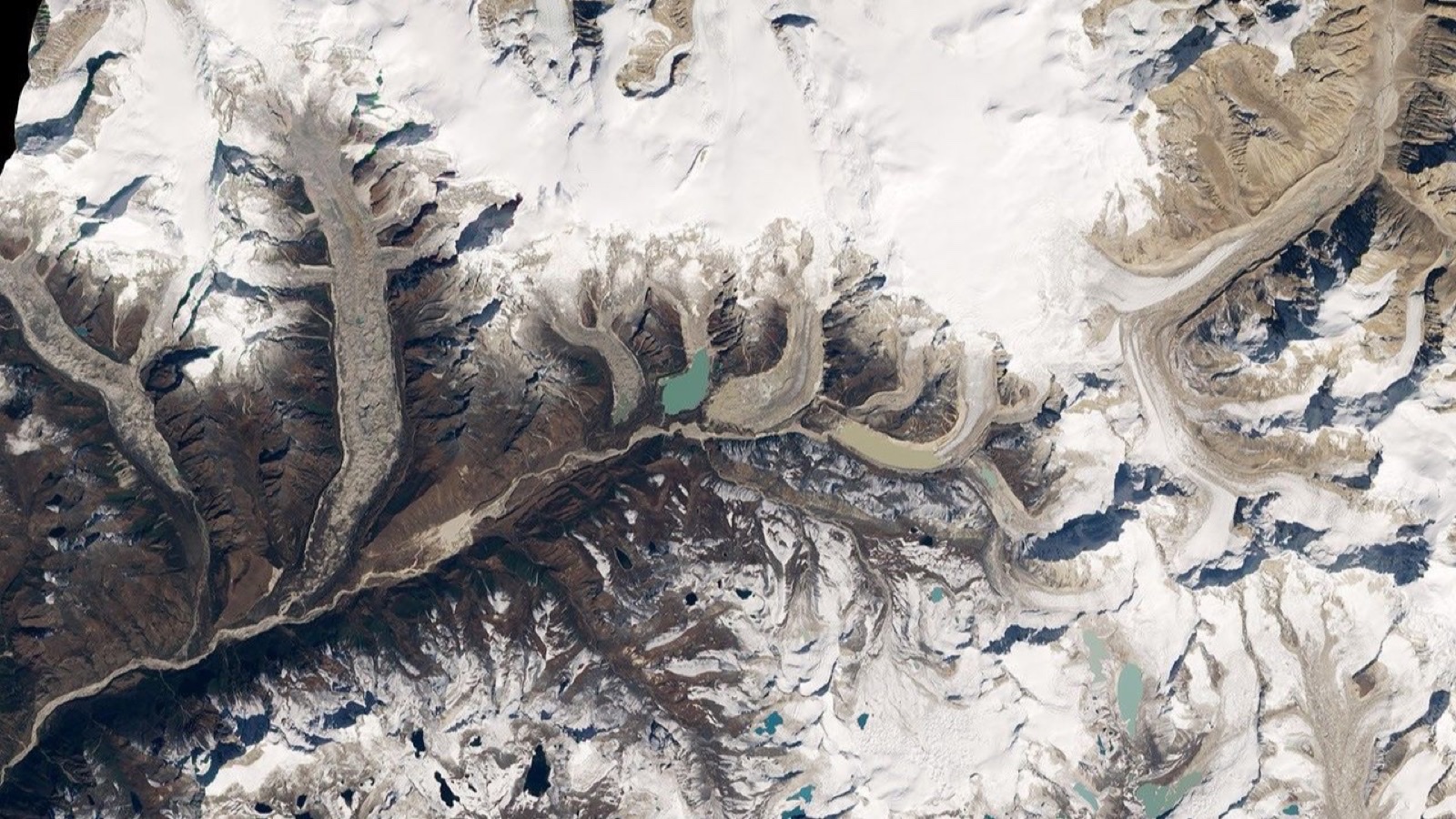 Caption: Glaciers in the Bhutan Himalaya, their tongues fringed by turquoise meltwater lakes — each pool a reservoir that did not exist a generation ago. NASA Earth Observatory image by Robert Simmon (EO-1 ALI); public domain.
The Crueller Arithmetic Upstream
Here the story widens from a single valley into something that will shape the century, because the ice now producing these floods is also the ice that two billion people are counting on.
The Hindu Kush Himalaya is often called the Water Towers of Asia, and the name is precise. Snow and ice across the range feed twelve major river systems — the Ganges, the Indus, the Brahmaputra, the Mekong, the Yangtze, and more — that supply water to roughly two billion people across sixteen countries. Around 240 million live in the mountains themselves; another 1.65 billion live downstream, in the plains and megacities that these rivers make habitable.
Glaciers are what make that supply reliable. They store water as ice through the wet season and release it slowly through the dry months, smoothing the year into something farmers and cities can plan around. They are, in effect, the largest freshwater savings account on Earth.
That account is being drawn down. On the current emissions path, the region could lose up to 80 percent of its glacier volume by 2100; even if the world holds warming to between 1.5 and 2 degrees, the loss is likely to be 30 to 50 percent. And here is the paradox that makes the Nepal flood a warning rather than merely a tragedy:
The same warming that is drowning villages with too much water today is quietly emptying the reservoir that two billion people will need tomorrow.
For a few decades, accelerating melt actually increases river flows — more water, more floods, more outbursts. This is the phase we are entering now. But a glacier can only melt once. Past the point of "peak water," the flows begin a long decline, and the dry-season trickle that sustained the plains for millennia starts to fail. The floods are the loud, visible symptom. The drought is the quiet one, arriving decades later, and it is the one that will move populations.
What the Flood Is Telling Us
It is tempting, and scientifically improper, to blame any single disaster on climate change. No one can say that this particular slope would have held in a cooler world. What the science says instead is more sober and more damning: the dice have been loaded. Warming has made collapses like this one more frequent, more powerful, and more likely to strike without the warning that weather provides. Scientists studying the region have begun, wearily, to call events like these "the new normal."
The phrase is almost too gentle. What is actually happening is that a mountain range the size of a continent is transitioning from one physical state to another — from a frozen, stable system to a wetter, looser, more violent one — over the span of a single human lifetime. The people who live beneath it did the least to cause the warming and stand most directly in the path of its consequences.
The flood that came under a clear sky was not an accident of weather. It was a preview. The Himalaya is coming apart at the pace we are heating it, and the water that tore through those Nepali valleys was, in the end, a message written in the one language a melting mountain has left: it comes down.